Do Solar Panels Work During a Power Outage? (2026 Guide)
Do Solar Panels Work During a Power Outage? Grid-Tied vs Battery Backup
Introduction
Solar panels help homeowners generate electricity, reduce their dependence on utility companies, and potentially lower their monthly energy bills. However, many homeowners in the United States have an important question: do solar panels work during a power outage?
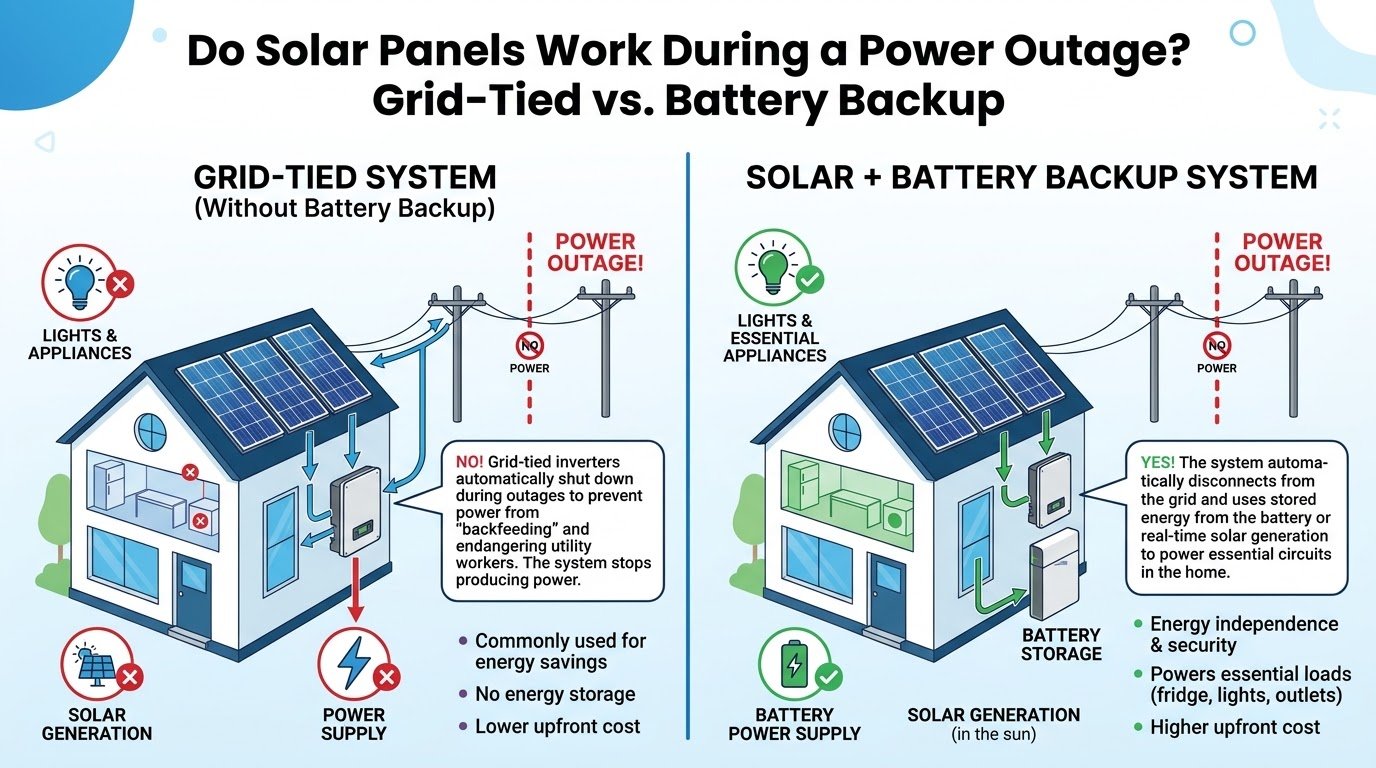
The answer depends on the type of solar energy system installed in your home. Although solar panels can continue receiving sunlight during a blackout, a standard grid-tied solar system usually shuts down automatically when the utility grid loses power. This safety feature prevents electricity from flowing into power lines that utility workers may be repairing.
Homeowners who want electricity during an outage generally need a properly configured solar battery backup system, a compatible inverter, and equipment that safely disconnects the home from the utility grid. The U.S. Department of Energy explains these requirements in its guide to solar energy and resilience.
In this guide, we explain how different solar systems operate during blackouts, what equipment you need for backup electricity, and how to choose the right setup for your home.
Do Solar Panels Work During a Power Outage?
Solar panels can generate electricity when sunlight reaches them, but generating electricity and supplying usable power to your home are two different things.
Most residential solar installations in the United States are connected to the utility grid. These systems typically use grid-following inverters that need a functioning grid connection to operate normally.
When the utility company experiences an outage, a standard grid-tied inverter detects the problem and shuts down. As a result, your home generally loses electricity even if the sun is shining and your solar panels are producing energy.
A solar system designed for backup operation works differently. With suitable equipment, it can disconnect from the utility grid and supply selected household circuits using solar electricity and stored battery energy.
Therefore, whether solar panels work during a blackout depends on your inverter, battery storage, electrical switching equipment, and system configuration.
Why Do Grid-Tied Solar Panels Shut Down During a Blackout?
The primary reason is safety.
A standard grid-tied solar system is designed to stop supplying electricity when it detects a grid outage. This protection is commonly called anti-islanding protection.
Without this safety mechanism, a solar installation could send electricity into utility lines that workers believe have been disconnected from the power supply. Unexpected electrical energy on those lines could create a serious hazard.
Anti-islanding protection helps prevent this situation by stopping the inverter from operating normally when the grid becomes unavailable.
Here is what generally happens during a blackout:
- The utility grid loses power.
- The solar inverter detects the loss of the grid connection.
- The inverter shuts down its normal grid-connected operation.
- The home stops receiving electricity from the solar system unless it has a suitable backup arrangement.
- Normal grid-connected operation resumes when the utility supply returns and the system verifies that the grid is safe.
This behavior is intentional. A grid-tied solar system without backup capability is designed primarily to generate electricity while the utility grid is operating, not to function independently during a blackout.
Grid-Tied Solar vs. Solar Battery Backup
Understanding the differences between solar system types can help you choose an installation that meets your electricity needs.
1. Grid-Tied Solar Systems
A grid-tied solar system connects rooftop solar panels to your home’s electrical system and the utility grid. It is a common option for homeowners who want to reduce electricity purchases.
During normal operation, solar panels supply electricity to household appliances. Depending on your system and local utility rules, excess electricity may be exported to the grid.
However, a conventional grid-tied system without backup equipment generally shuts down during a power outage.
Advantages:
- Can reduce electricity purchased from the utility.
- Usually has a simpler configuration than a solar-plus-storage system.
- Does not require a home battery.
- May work with utility export or net billing programs, depending on local policies.
Disadvantages:
- Usually cannot power your home during a blackout.
- Does not provide stored electricity after sunset.
- Offers limited protection against grid interruptions.
A grid-tied system can be a practical choice if your primary goal is reducing electricity costs rather than maintaining power during outages.
2. Solar Systems With Battery Backup
A solar-plus-battery system combines solar panels with energy storage and equipment capable of operating independently from the grid.
During sunny weather, the panels can supply household electricity and charge the battery when conditions and system settings allow. If the utility grid fails, compatible backup equipment isolates the home from the grid and supplies electricity to designated circuits.
The battery can then provide power even when solar production falls, such as during the evening or on cloudy days, until its available energy is depleted.
Advantages:
- Can provide backup electricity during a blackout.
- Stores solar energy for use after sunset.
- Can support essential appliances and selected circuits.
- May reduce reliance on a generator during some outages.
Disadvantages:
- Adds equipment and installation costs.
- Provides a limited amount of stored energy.
- Requires compatible inverters and properly configured backup controls.
- May not power every appliance in the house.
A battery alone does not guarantee backup power. The complete system must be designed for outage operation.
What Equipment Is Needed for Solar Power During an Outage?
If you want to use solar energy during a blackout, ask your installer about the following components.
Solar Panels
Solar panels generate direct-current electricity from sunlight. During an outage, they can continue producing energy, but the rest of the system must be able to use that energy safely without the utility grid.
Battery Storage
A home battery stores electricity for later use. Battery capacity, measured in kilowatt-hours (kWh), helps determine how much energy is available to run appliances and for how long.
A larger battery generally stores more energy, but the actual backup duration depends on household consumption, usable battery capacity, and system efficiency.
Hybrid or Backup-Capable Inverter
The inverter converts electricity into a form suitable for household appliances. A backup-capable or compatible hybrid inverter can help manage solar generation, battery charging, and independent operation when the grid is unavailable.
Not every hybrid inverter supports backup operation, so check the manufacturer’s specifications and the installed system configuration.
Backup Gateway or Transfer Switch
This equipment safely disconnects the home’s backup supply from the utility grid during an outage. Depending on the system, it may automatically switch the home to backup power and reconnect it after utility service returns.
Critical-Loads Panel
Some installations provide backup power only to selected circuits rather than the entire home. A critical-loads panel can supply essential equipment such as refrigerators, lights, internet routers, and selected outlets.
For more information, consult the U.S. Department of Energy’s solar and resilience guide.
How Long Can Solar Battery Backup Power Your Home?
Backup duration depends on your battery’s usable capacity and the total electricity consumption of the appliances connected to it.
You can estimate the approximate runtime using this simple formula:
Backup runtime (hours) = Usable battery capacity (kWh) ÷ Average load (kW)
For example, suppose your battery has 10 kWh of usable energy and your essential appliances consume an average of 1 kW.
10 kWh ÷ 1 kW = approximately 10 hours.
This is a simplified estimate. Real-world runtime can be shorter because of inverter losses, changing appliance demand, battery reserve settings, and other system limitations.
Consider the following illustrative examples:
| Usable battery energy | Average load | Approximate runtime |
|---|---|---|
| 5 kWh | 0.5 kW | 10 hours |
| 10 kWh | 1 kW | 10 hours |
| 15 kWh | 1.5 kW | 10 hours |
These examples assume the stated energy is available for use and the load remains constant. They are not guarantees of actual performance.
Running an air conditioner, electric water heater, electric oven, or other high-power appliance can drain a battery much faster than running a few lights and a refrigerator.
Can Solar Panels Recharge a Battery During a Blackout?
Yes, if the complete system supports solar charging while operating independently from the grid.
A properly configured solar-plus-storage installation may use daytime solar production to power household loads and recharge the battery. This can extend backup availability during a prolonged outage.
However, several factors affect charging performance:
- The amount of sunlight reaching the panels.
- The size and condition of the solar array.
- Cloud cover and weather conditions.
- Household electricity consumption during the day.
- Battery capacity and charging limits.
- Whether the inverter supports operation and battery charging without a functioning grid.
Some systems also have specific restart requirements after their batteries become fully depleted. Ask your installer whether the equipment can restart and resume solar charging while the grid remains unavailable.
Without sufficient sunlight or stored energy, a solar battery system may eventually stop supplying electricity.
Can You Use Solar Panels During an Outage Without a Battery?
Some solar systems offer limited daytime backup without a battery through specialized inverter features or dedicated outlets.
However, this capability is not available on every system. It may provide power only when sufficient sunlight is available, and the amount of usable electricity can vary with changing weather and appliance demand.
A battery-free setup also generally cannot provide stored energy after sunset.
For homeowners who need dependable backup for refrigerators, lighting, internet equipment, and other essential appliances, a properly configured solar battery system is usually a more practical option.
Do not assume your existing grid-tied panels will provide electricity during a blackout. Check the inverter manual and ask a qualified installer to confirm the system’s capabilities.
How to Prepare Your Home for a Power Outage
If reliable backup electricity is important to your household, take these steps before installing or upgrading your solar system.
1. Identify Essential Appliances
Make a list of the appliances you need during a blackout. Common examples include a refrigerator, lights, phone chargers, internet equipment, medical devices, and selected kitchen appliances.
Check the operating power and startup requirements of each device.
2. Calculate Your Backup Energy Needs
Estimate how much electricity those appliances consume over several hours. This will help you determine the battery capacity needed for your preferred backup duration.
Remember that the inverter’s power rating also matters. A battery may contain enough energy but still be unable to start or operate an appliance whose power demand exceeds the inverter’s limits.
3. Choose Compatible Equipment
Ask your solar installer to confirm that the panels, inverter, battery, and backup switching equipment work together during an outage.
If you already have solar panels, a retrofit may be possible, but the required changes depend on the existing equipment.
4. Decide Between Essential-Loads and Whole-Home Backup
Essential-loads backup generally powers selected circuits. Whole-home backup may support more appliances, but it often requires a larger battery, suitable inverter capacity, and additional electrical equipment.
Your choice should reflect your budget, energy usage, and the duration of outages you want to manage.
5. Check Local Utility Requirements
Solar and battery installations must comply with applicable electrical codes, utility interconnection rules, and local permitting requirements. Have a qualified professional design and install the system.
Is Solar Battery Backup Worth It in the USA?
Solar battery backup may be worthwhile for homeowners who experience frequent outages, work from home, rely on essential electrical equipment, or want more control over when they use stored solar energy.
However, it is not automatically the best financial choice for every household.
Before purchasing a battery, consider:
- How often outages occur in your area.
- How long outages usually last.
- The installed cost of the battery and associated equipment.
- The amount of electricity you need during an outage.
- Potential utility bill savings and applicable rate plans.
- Battery warranty, lifespan, and replacement considerations.
Homeowners should compare the financial benefits with the value of backup electricity. A battery purchased mainly for emergency use may have a different financial justification from one that also helps manage time-of-use electricity rates.
The U.S. Department of Energy provides additional information about solar integration and energy storage.
Frequently Asked Questions
Do solar panels automatically work when the power goes out?
Usually not if you have a standard grid-tied solar system without backup capability. The inverter normally shuts down when the grid fails. A properly configured backup system may continue supplying electricity.
Will solar panels charge my battery during a blackout?
They can if the solar array, battery, inverter, and backup controls support off-grid operation and solar charging during an outage.
Can a solar battery power an entire house?
It depends on the battery’s usable capacity, inverter power rating, household electricity demand, and backup configuration. Some systems power selected circuits, while appropriately sized systems may support whole-home backup.
Can solar panels power a refrigerator during a blackout?
Yes, if your system has a suitable backup configuration and enough available power and energy to run the refrigerator. Remember to account for the compressor’s startup demand.
What happens when the battery runs out?
The backup supply may shut down when the battery reaches its minimum operating level. If the system supports independent solar charging, sunlight may help recharge the battery and restore power. Otherwise, electricity may remain unavailable until the grid returns or another compatible power source is available.
Is a hybrid inverter enough for blackout protection?
Not necessarily. The inverter must support backup operation, and the complete installation must include the required battery or other supported energy source and safe grid-isolation equipment.
Final Thoughts
Solar panels can help homeowners reduce their dependence on utility electricity, but a standard grid-tied solar system usually does not provide power during a blackout.
If you want to keep essential appliances running when the grid fails, consider a properly designed solar-plus-battery system with a compatible inverter and safe backup switching equipment.
Before making a purchase, calculate your essential energy needs, compare battery options, and confirm that your chosen system can operate independently from the grid. A qualified solar installer can help you select equipment that matches your home, budget, and backup requirements.
Disclaimer: This article is for general educational purposes only. Solar performance, backup capabilities, electrical requirements, and utility policies vary by installation and location. Consult qualified professionals and official local requirements before making installation decisions.