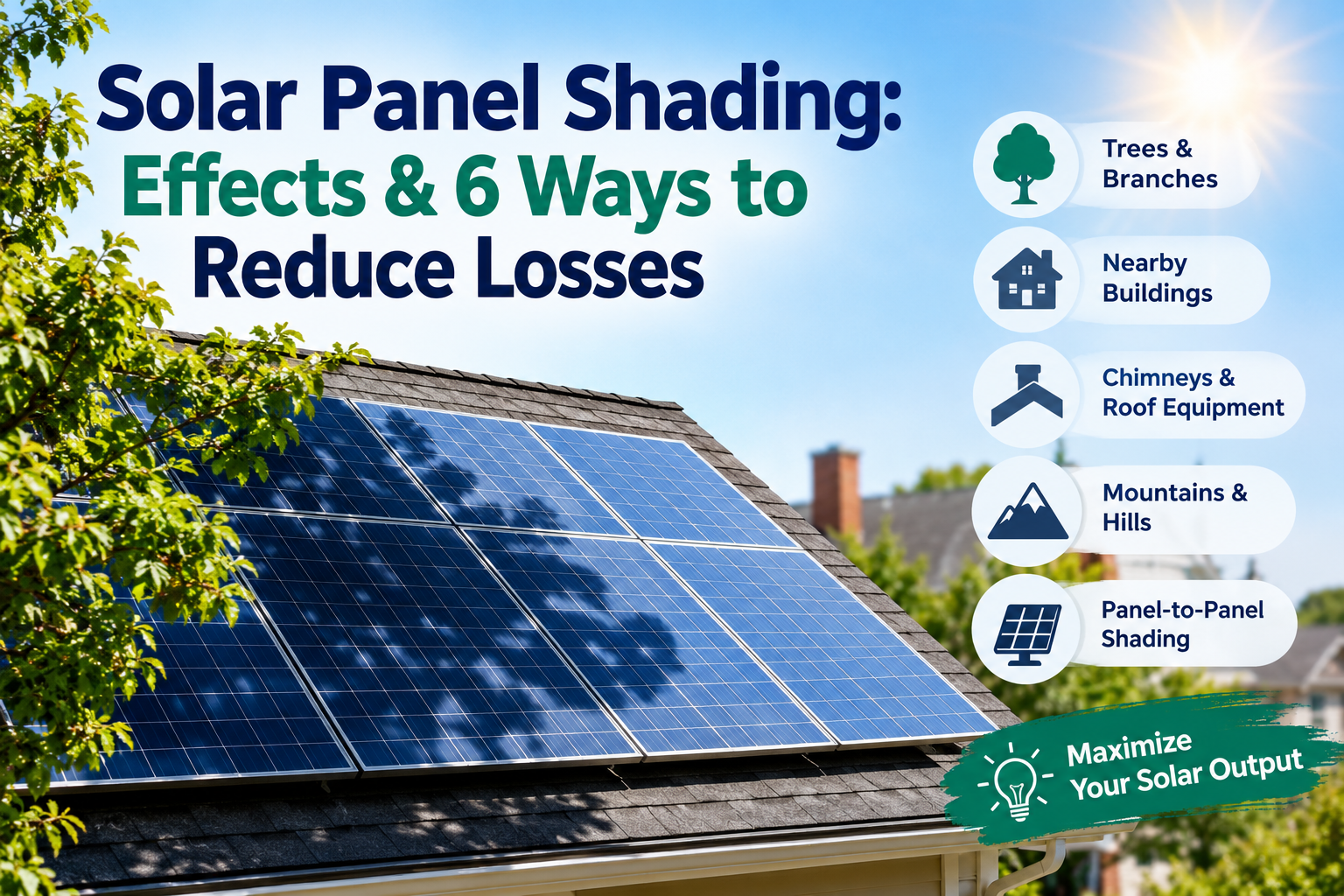
Solar Panel Shading: Effects & 6 Ways to Reduce Losses
How Does Solar Panel Shading Affect Electricity Production?
Solar panels need sunlight to generate electricity efficiently, but what happens when trees, buildings, chimneys, or other objects cast shadows on them? Even partial shading can reduce solar energy production and affect the overall performance of a residential solar system.
For homeowners in the United States, understanding solar panel shading is important before installing a rooftop solar system. Proper panel placement, shade analysis, and suitable system design can help reduce unnecessary energy losses and improve long-term performance.
In this guide, we explain how shading affects solar panels, which objects cause the most common problems, how to identify shading losses, and what homeowners can do to minimize them.
What Is Solar Panel Shading?
Solar panel shading occurs when an object blocks some or all of the sunlight that would otherwise reach a photovoltaic (PV) panel. The object may create a shadow over an entire panel, a small section of a panel, or several panels at once.
Common sources of shading include:
- Trees and overgrown branches
- Nearby houses and commercial buildings
- Chimneys, vents, and rooftop equipment
- Utility poles and overhead structures
- Mountains or hills near the installation
- Neighboring solar panels that cast shadows on each other
Shading can change throughout the day and across different seasons. For example, a tree may cast a shadow over a roof in the morning but leave the panels fully exposed around midday. During winter, the sun follows a lower path across the sky, which can cause longer shadows.
The amount of electricity lost depends on the shading pattern, its duration, the solar panel design, and the electrical configuration of the system.
How Does Shading Affect Solar Panel Electricity Production?
Solar panels convert sunlight into direct-current electricity. When sunlight reaches their photovoltaic cells, those cells generate electrical current. Blocking sunlight reduces the energy available for conversion.
However, the relationship between shaded area and electricity loss is not always proportional. A small shadow can sometimes cause a disproportionately large reduction in power, particularly when it affects cells connected in series.
The National Renewable Energy Laboratory (NREL) explains that partial shading can have a significant impact on photovoltaic system output. The exact effect depends on the module and system configuration.
1. Reduced Power Output
When sunlight is blocked, shaded cells generally produce less current. Depending on how the cells are interconnected, this can restrict the output of a larger portion of a panel or array.
For example, a solar panel that produces 400 watts under suitable test conditions will not necessarily continue producing that output when part of it is shaded. Its actual output depends on the available sunlight, temperature, and electrical operating conditions.
2. Lower Daily Energy Production
Even if shading occurs for only a few hours, the lost production can accumulate over time. A roof that experiences morning shade every day may generate less electricity annually than an otherwise similar, unobstructed roof.
This can affect how much electricity a household purchases from its utility company and how quickly the solar installation recovers its upfront cost.
3. Uneven Performance Across Panels
If one panel receives full sunlight while another is shaded, their electrical outputs may differ considerably. In some systems, the mismatch can also affect other modules connected to the same electrical string.
The extent of this effect depends on the inverter, wiring arrangement, bypass diodes, and whether the system uses module-level power electronics.
4. Potential Hot Spots
Under certain electrical conditions, shaded solar cells can experience reverse-bias stress and localized heating, known as hot spots. Modern modules use protective features, including bypass diodes, to reduce some shading-related risks.
These protections do not eliminate every potential problem. Persistent or unusual shading should be assessed by a qualified solar professional, particularly if the system shows visible damage or abnormal performance.
Which Objects Cause the Most Solar Panel Shading?
Understanding where shadows originate can help homeowners choose a better installation location.
Trees and Branches
Trees are one of the most common sources of rooftop shading. Their shadows change as the sun moves, and their branches may grow over time.
Before installation, assess both current tree coverage and likely future growth. Where appropriate, selective trimming may reduce shading, but homeowners should consider tree health, local regulations, and safety.
Nearby Buildings
A neighboring house, garage, apartment building, or commercial structure can block sunlight from reaching a rooftop array. The effect depends on the height and distance of the structure, roof orientation, and the sun’s position throughout the year.
Chimneys and Roof Equipment
Chimneys, plumbing vents, HVAC equipment, antennas, and similar roof features may cast small but recurring shadows across nearby panels.
A professional installer can use roof measurements and shade-analysis tools to identify suitable panel positions before installation.
Seasonal and Self-Shading
Shading does not always come from objects outside the solar installation. Panels arranged in rows may cast shadows on other rows when the sun is low. This is known as self-shading.
A well-designed layout considers panel spacing, tilt angle, roof geometry, and the sun’s seasonal path to reduce these losses.
Does Partial Shading Affect All Solar Panels Equally?
No. The impact of shading varies according to panel construction and system design.
Conventional String Inverters
In a conventional string system, several solar panels are electrically connected in a series. Shading on one panel may reduce the output of the affected panel and, depending on the arrangement and operating conditions, influence the string’s overall performance.
This does not mean that every shaded panel will cause the entire solar system to stop producing electricity.
Bypass Diodes
Many crystalline-silicon solar modules contain bypass diodes. These components provide an alternative current path around certain groups of shaded cells when operating conditions trigger them.
Bypass diodes can reduce some shading-related losses, but they do not prevent all power reduction. When a group of cells is bypassed, its contribution to the module’s voltage and power is reduced.
Microinverters and Power Optimizers
Microinverters convert DC electricity to AC at the individual panel level. Power optimizers manage the electrical output of individual modules while working with a compatible central inverter.
These technologies can reduce the impact of differences between panels, depending on the equipment and shade pattern. However, they cannot restore sunlight blocked by a tree or building.
Homeowners considering these options should compare the equipment cost, warranty, monitoring features, and expected production benefits with an experienced installer.
How to Reduce Solar Panel Shading Losses
Although some properties cannot avoid every shadow, several practical measures can help improve solar energy production.
1. Conduct a Shade Analysis Before Installation
A shade analysis evaluates how nearby objects affect sunlight reaching the proposed solar array. Installers may use site surveys, sun-path assessments, and specialized software to estimate shading at different times of day and year.
Ask your installer to explain the expected shading losses and how they are included in the production estimate.
2. Choose the Best Roof Area
Whenever practical, place panels on roof sections that receive strong, consistent sunlight during the most productive hours of the day.
The best roof area depends on the property’s location, orientation, roof shape, utility requirements, and seasonal shading patterns. Avoid assuming that one direction or roof section is ideal for every home.
3. Maintain Trees and Vegetation
Trim branches only where appropriate and safe. If trees cannot be altered, an installer may be able to reposition the panels or design separate electrical strings around the shaded areas.
Do not attempt dangerous tree work near power lines or climb onto a roof without suitable professional equipment.
4. Consider Shade-Tolerant System Design
Where partial shade cannot be avoided, ask about module-level power electronics or alternative array layouts. A qualified installer can determine whether microinverters, power optimizers, or separate strings are appropriate for the property.
The best choice depends on the shading pattern and total system cost rather than the equipment label alone.
5. Monitor Solar Energy Production
Most modern inverters and solar monitoring platforms let owners track daily or monthly electricity generation. Monitoring can help identify unusual changes in output.
Compare production across similar weather conditions and seasons. A reduction may be caused by shading, cloud cover, dirt, equipment issues, or other factors, so investigate before assuming that a panel is faulty.
6. Keep Panels Clean and Inspect the System
Dust, leaves, bird droppings, and other debris can block sunlight even when there is no shadow from a building or tree. Follow the panel manufacturer’s cleaning and maintenance guidance.
If production falls unexpectedly, ask a qualified technician to inspect the system. Never disconnect electrical components or open inverter equipment unless you are qualified to do so.
How Can You Estimate Solar Panel Shading Losses?
A reliable estimate requires more than measuring the visible shadow on a roof. Shading changes throughout the day and year, and electrical effects can make the resulting production loss different from the shaded surface area.
A practical assessment can include the following steps:
- Identify nearby trees, buildings, chimneys, and other obstructions.
- Record when each object casts a shadow on the proposed panel locations.
- Evaluate seasonal differences, especially when the sun is lower in winter.
- Use a solar design tool or professional shade-analysis report to estimate annual losses.
- Compare the estimated production with the property’s electricity usage.
The U.S. Department of Energy’s National Renewable Energy Laboratory provides PVWatts, a free online calculator that estimates photovoltaic system energy production. Its results depend on the information entered, and users should account for significant shading rather than relying blindly on default assumptions.
Official tool: https://pvwatts.nlr.gov/pvwatts.php
PVWatts is useful for preliminary estimates, but a detailed site-specific shade analysis may be necessary for a property with substantial obstructions.
Example: How Shading Can Affect a Home Solar System
Consider a hypothetical home with a 6-kilowatt solar installation.
Suppose its estimated annual production before additional shading losses is 8,000 kilowatt-hours (kWh). If a detailed assessment estimates an additional annual shading loss of 10%, the simplified production estimate becomes:
- Estimated annual production without that shading loss: 8,000 kWh
- Assumed additional shading loss: 800 kWh
- Estimated annual production after that loss: 7,200 kWh
These figures are illustrative, not a prediction for a particular home. Actual output and shading losses depend on location, weather, system design, existing loss assumptions, and the timing and pattern of shadows.
A professional assessment can help determine whether changing panel placement or system design would make a meaningful difference.
Is It Worth Installing Solar Panels on a Shaded Roof?
A shaded roof is not automatically unsuitable for solar panels. The important question is how much sunlight the available roof area receives over the year and whether the expected electricity production justifies the installation cost.
A property with occasional, limited shading may still support a useful solar system. A roof that remains heavily shaded during productive hours may require a different panel location or may offer less financial value.
Before making a decision, ask for an estimate that includes:
- Expected annual electricity production
- Shading losses by roof section, if available
- System equipment and installation costs
- Expected utility bill savings under local rates and export rules
- Maintenance, warranty, and financing considerations
Compare proposals using the same assumptions so you can understand whether a more expensive system is likely to deliver enough additional value.
Frequently Asked Questions
Can a small shadow reduce solar panel output significantly?
Yes. Depending on the cells affected and the system’s electrical design, a small shadow can cause a larger-than-expected power reduction. The impact is not determined by shaded area alone.
Do solar panels work in partial shade?
Yes. Solar panels can still generate electricity in partial shade, although their output may be reduced. The amount of energy produced depends on the available sunlight, panel technology, and system configuration.
Are microinverters better for shaded roofs?
Microinverters can help panels operate more independently, which may reduce mismatch losses in some shaded installations. They do not eliminate shading losses, and the benefits depend on the roof layout and equipment.
Can trees completely block solar production?
A tree that blocks direct sunlight can substantially reduce production during the affected period. Panels may still receive diffuse sunlight, but output will generally be lower than under unobstructed conditions.
Does shading affect solar panels more in winter?
It can. The sun’s lower winter path may create longer shadows, although the actual effect varies by location, tree coverage, roof orientation, and time of day.
How do I know if shading is reducing my solar system’s output?
Review inverter monitoring data, compare production under similar weather conditions, and check for recurring shadows. A qualified solar technician can perform a detailed assessment if the reduction is unexplained.
Final Thoughts
Solar panel shading is an important factor when planning a residential solar installation. Trees, nearby buildings, chimneys, and other obstructions can reduce electricity production, sometimes by more than the shaded area alone might suggest.
The most effective approach is to assess the site before installation, choose suitable panel locations, consider appropriate inverter technology, and monitor system performance over time.
For US homeowners, a professional shading assessment and a realistic annual production estimate can help prevent disappointing results and support a more informed solar investment decision.
Disclaimer: This article provides general educational information, not a site-specific engineering or financial assessment. Solar output and savings vary by property, weather, equipment, electricity rates, and utility policies.