
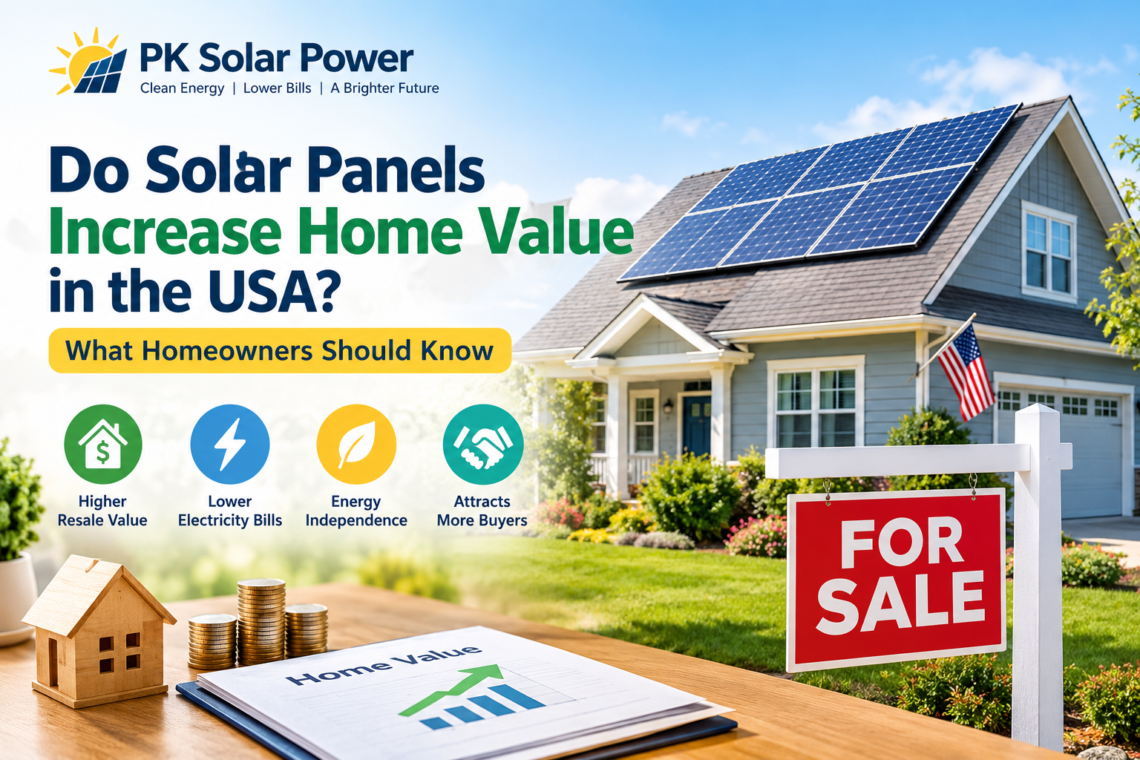
Do Solar Panels Increase Home Value in the USA? What Homeowners Should Know
Meta Title: Do Solar Panels Increase Home Value? 7 Key Facts
Meta Description: Discover how solar panels affect home value in the USA, including resale benefits, energy savings, ownership, financing, and buyer considerations.
Focus Keyword: Do solar panels increase home value
Secondary Keywords: solar panels home value USA, solar panel resale value, solar energy home value, selling a house with solar panels, owned vs leased solar panels
Suggested Permalink: solar-panels-home-value-usa
Introduction
Solar energy has become an important consideration for homeowners across the United States. As electricity costs, energy independence, and environmental concerns influence buying decisions, many property owners are considering rooftop solar panels as a long-term investment.
One common question is: Do solar panels increase home value in the USA?
The answer is often yes, particularly when the homeowner owns a well-maintained solar system that produces meaningful electricity savings. However, the amount of additional value depends on several factors, including the property’s location, the condition and age of the panels, local electricity prices, and whether the solar system is owned, leased, or financed.
Solar panels do not automatically increase every home’s selling price. Understanding how buyers, real estate agents, and appraisers evaluate solar installations can help homeowners make better decisions before installing panels or putting their properties on the market.
1. Do Solar Panels Increase Home Value?
Solar panels can increase a property’s market value because they may reduce electricity expenses for future homeowners. A home that generates part of its own electricity can be attractive to buyers who want greater control over their energy bills.
Research from Lawrence Berkeley National Laboratory found that buyers in an earlier, multistate study were willing to pay a premium for homes with homeowner-owned solar photovoltaic systems. The study examined nearly 22,000 home sales, including approximately 4,000 properties with solar installations, across eight states.
The researchers estimated an average premium of about $4 per watt of installed solar capacity in the historical market they studied. This is an important finding, but it should not be treated as a current national price estimate or a guarantee of the amount a home will gain in value.
Source: https://emp.lbl.gov/news/59401/berkeley-lab-illuminates-price-
The practical takeaway is that an owned solar system can contribute to a property’s appeal and value. The actual premium for a particular home must be evaluated using current local market conditions and comparable property sales.
2. Why Homebuyers May Pay More for a Solar-Powered Home
Several factors can make a solar-powered property more attractive to prospective buyers.
Lower Electricity Bills
One of the biggest advantages is the potential to reduce electricity purchases from the utility company. The amount saved depends on the system’s production, household electricity consumption, utility rates, and the rules for compensating customers for excess electricity.
Buyers may be more interested in a home when the seller can provide clear records of past energy production and electricity bills.
Greater Energy Independence
Solar panels allow a property to generate electricity on-site. Although a typical grid-connected solar system does not provide power during an outage without suitable backup equipment, it can still reduce reliance on electricity purchased from the grid.
Homes with appropriately configured solar batteries may offer additional backup capabilities.
Long-Term Energy Savings
A solar system can continue producing electricity for many years. Buyers may consider the expected future savings when comparing a solar-powered home with a similar property without solar.
However, the remaining useful life of the panels, inverter replacement costs, maintenance requirements, and financing obligations should also be considered.
Environmental Considerations
Some buyers prefer homes that generate renewable electricity and may view solar installations as a desirable feature. The importance of this benefit varies according to individual preferences and local market demand.
3. Which Solar Systems Add More Value: Owned or Leased?
Ownership is one of the most important factors when assessing the effect of solar panels on home value.
Homeowner-Owned Solar Panels
When a homeowner purchases a solar system outright, the panels generally become an asset associated with the property. The owner can present the system’s specifications, warranty information, electricity production records, and operating history to prospective buyers.
An owned system may be easier to evaluate during a sale because there is no separate solar lease that the buyer must assume.
Solar Panels Purchased With a Loan
A solar loan can also affect the sale process. The homeowner should review the loan agreement to determine the outstanding balance, repayment terms, and whether the loan must be paid off or can be transferred to an eligible buyer.
A buyer’s willingness to purchase the property may depend on the total financial obligations associated with the system.
Leased Solar Panels
With a solar lease, a third-party company generally owns the equipment and the homeowner pays according to the lease agreement.
The buyer may need to qualify to assume the lease, or the seller may need to arrange another solution with the provider. Transfer requirements, monthly payments, and contract terms can complicate the transaction.
A Lawrence Berkeley National Laboratory study of third-party-owned solar homes found no evidence that these properties sold for more or less than comparable homes without solar in the markets examined. This demonstrates why leased systems should not automatically be assumed to increase resale value.
Source: https://emp.lbl.gov/news/berkeley-lab-report-says-solar-homes
Before listing a property, homeowners should contact their solar provider and obtain written instructions about transferring or settling the agreement.

4. What Factors Determine How Much Value Solar Panels Add?
There is no single amount that every homeowner can expect to receive from a solar installation. Several factors influence the result.
Location of the Property
Solar installations may be more attractive in areas with high electricity prices, favorable solar production, and strong demand for renewable energy.
Local utility policies also matter. Compensation for electricity exported to the grid differs by state and utility, so two similar systems may deliver different financial benefits.
Age and Condition of the Solar Panels
Newer systems generally have more remaining operating life than older installations, all else being equal.
Buyers may want to know the installation date, equipment specifications, maintenance history, warranty coverage, and whether any repairs are needed.
System Size and Electricity Production
A larger system is not automatically more valuable. Its usefulness depends on how well its production matches the household’s electricity needs and whether the roof can support the installation appropriately.
Recent electricity bills and solar production reports can help buyers understand the system’s real-world performance.
Roof Condition
A roof in good condition can make a solar installation easier to evaluate. If the roof requires replacement soon, buyers may be concerned about the cost of removing and reinstalling the panels.
Homeowners planning to install solar should consider the roof’s remaining life before proceeding.
Local Real Estate Market
The final sale price depends on supply and demand, comparable properties, interest rates, property condition, and buyer preferences.
Solar panels may be a useful selling feature, but they cannot guarantee a higher price or a faster sale.
5. How to Estimate the Added Value of Solar Panels
Homeowners can start by gathering reliable information about their system and comparing it with recent property sales.
Consider the following steps:
- Calculate annual electricity savings. Review utility bills and solar production records to estimate how much electricity the system offsets.
- Check the system’s age. Determine how long the panels and inverter have been operating and review their warranties.
- Review ownership documents. Confirm whether the system is owned outright, financed, or leased.
- Compare similar homes. Look for recent sales of comparable properties with and without owned solar systems in the same local market.
- Request a professional valuation. Ask a qualified local real estate agent or appraiser to explain how solar features may be reflected in the property’s market value.
Avoid estimating added home value solely by multiplying the system’s original installation cost by a percentage. Installation costs and resale value are not necessarily equal, and older systems may have a different market value from new ones.
6. Does Solar Panel Installation Cost Affect Home Resale Value?
The installation price is important when evaluating the overall return on investment, but a homeowner should not assume that spending $25,000 on solar panels will increase the home’s sale price by $25,000.
The value of the installation depends on the electricity savings it can deliver, its remaining useful life, equipment condition, and local buyer demand.
For example, consider a hypothetical homeowner who spends $20,000 on an owned solar system. Over time, the system reduces electricity expenses, but the eventual resale premium might be lower or higher than expected.
The homeowner should evaluate the total financial picture, including:
- Upfront installation expenses.
- Financing interest and fees, if applicable.
- Electricity savings over the ownership period.
- Maintenance and potential equipment replacement.
- Any applicable incentives or utility compensation.
- The estimated resale value when the property is sold.
A solar installation can be worthwhile even when its entire cost is not recovered through a higher selling price, because the owner may also benefit from years of electricity savings.
7. Are Solar Panels a Good Investment for Homeowners in 2026?
Solar panels may be a good investment for homeowners who plan to stay in their properties for several years and can achieve meaningful electricity savings.
Before investing, homeowners should obtain multiple installation quotes, compare equipment warranties, evaluate financing options, and check the rules of their electricity provider.
They should also verify current federal, state, and local incentives rather than relying on outdated online articles.
Important tax update for 2026: The federal Residential Clean Energy Credit under Section 25D is not available for qualifying residential clean-energy expenditures made after December 31, 2025, under current federal law. Homeowners considering a new installation in 2026 should not assume they qualify for the former 30% residential federal credit. State, local, utility, or other programs may have separate eligibility requirements.
Official source: https://www.irs.gov/credits-deductions/residential-clean-energy-credit
Tax rules can change, so homeowners should verify current eligibility with the IRS or a qualified tax professional before making financial decisions.
8. How to Make a Solar-Powered Home More Attractive to Buyers
Homeowners preparing to sell a solar-powered property can take several practical steps to make the installation easier to evaluate.
Keep Solar Documentation Organized
Prepare a folder containing the installation contract, equipment specifications, warranty documents, permits, inspection records, and any relevant utility interconnection paperwork.
Provide Electricity Bills and Production Reports
Showing actual electricity usage and solar generation can help buyers understand the potential financial benefits of the system.
Explain any major changes in household occupancy or electricity consumption that could affect comparisons.
Explain the Ownership Structure
Clearly disclose whether the system is owned outright, financed through a loan, or leased. Provide the relevant transfer or payoff information early in the selling process.
Maintain the Equipment
Address known faults, keep monitoring equipment operational where possible, and make sure the installation is in suitable condition before showings.
Work With a Knowledgeable Real Estate Professional
An agent familiar with solar-powered homes can help present the installation accurately and identify relevant comparable sales.
The goal is not to promise buyers a particular return, but to provide reliable information that helps them assess the property’s energy features.
9. Common Mistakes to Avoid When Selling a House With Solar Panels
Homeowners can make the sales process more difficult by overlooking important details.
Assuming every solar installation increases value: Market conditions and system ownership can produce very different outcomes.
Ignoring an outstanding loan: Buyers need to understand whether the loan must be settled or can be transferred.
Failing to disclose a lease: A solar contract can create additional obligations for the next owner.
Overstating electricity savings: Savings depend on household usage, utility rates, solar production, and compensation arrangements.
Ignoring roof repairs: A roof replacement can affect the cost and timing of a property sale.
Relying on outdated tax information: Federal and state incentives can change, making older online guides inaccurate.
Preparing accurate records and discussing these issues early can help avoid delays and misunderstandings.

Frequently Asked Questions
Do solar panels always increase home value?
No. Owned solar panels can add value in some markets, but the outcome depends on the system’s condition, ownership, electricity savings, and local real estate demand. A higher sale price is not guaranteed.
How much value do solar panels add to a house?
There is no universal dollar amount. Historical research found premiums for homeowner-owned systems, but the results should not be used as a guaranteed estimate for a property sold in 2026. A local appraisal or comparable-sales analysis is more appropriate.
Are leased solar panels bad when selling a house?
Not necessarily. However, the lease may need to be transferred, assumed by a qualified buyer, or settled according to the contract. Buyers should understand the remaining payments and transfer requirements.
Do solar panels make a house sell faster?
They may attract buyers who value lower electricity costs and renewable energy, but there is no guarantee of a faster sale. Pricing, location, property condition, and local demand remain important.
Should I install solar panels before selling my house?
It depends on your expected ownership period, installation costs, potential energy savings, and local buyer demand. If you plan to sell soon, compare the expected financial benefits with the full installation expense before proceeding.
Does the federal solar tax credit still apply to new residential installations in 2026?
Under current federal law, the Residential Clean Energy Credit is unavailable for qualifying expenditures made after December 31, 2025. Homeowners should verify the current rules and investigate any applicable state or utility incentives.
Conclusion
Solar panels can increase home value in the USA, particularly when a homeowner-owned system is in good condition and provides meaningful electricity savings. However, the impact varies by location, equipment age, ownership structure, utility policies, and local real estate conditions.
Homeowners can make their properties more attractive by maintaining the system, keeping clear records, explaining ownership and financing terms, and providing credible electricity production information.
Ultimately, solar panels should be evaluated as part of the property’s overall financial and practical benefits rather than as a guaranteed increase in resale price. Anyone planning to install or sell a solar-powered home should compare local market evidence and current energy policies before making a decision.
Disclaimer: This article is for general informational purposes only and does not constitute real estate, financial, legal, or tax advice. Property valuations, utility rules, and incentive eligibility vary by location and individual circumstances.




One comment on “Do Solar Panels Increase Home Value in the USA”