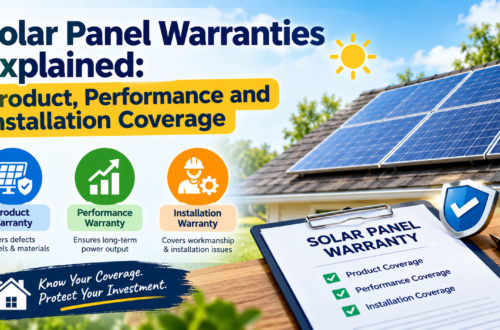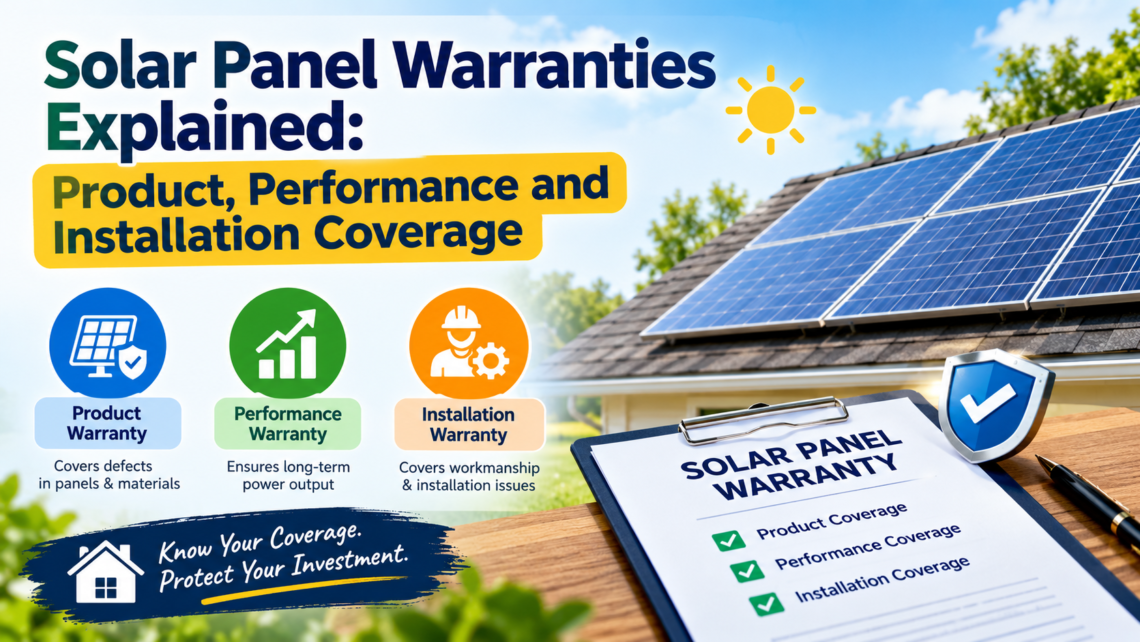
Solar Panel Warranties Explained: Product, Performance and Installation Coverage
Solar Panel Warranties Explained: Product, Performance and Installation Coverage is an essential guide for homeowners planning to install solar panels in the United States. Solar energy systems can operate for decades, but understanding their warranty coverage is just as important as choosing the right panels, inverter, and installer.
Solar warranties help protect homeowners against certain manufacturing defects, excessive power degradation, and installation-related problems. However, not every warranty covers the same issues, and a long warranty period does not automatically mean every repair will be free.
In this guide, you will learn about the main types of solar panel warranties, what they cover, what they exclude, how to make a warranty claim, and how to compare warranty terms before purchasing a solar system.
What Is a Solar Panel Warranty?
A solar panel warranty is a written agreement that describes the manufacturer’s or installer’s responsibility when specific problems occur within a defined period.
A residential solar installation may include several separate warranties. These can cover solar panels, inverters, batteries, mounting equipment, and installation workmanship.
For example, a manufacturer may guarantee that its panels will remain free from specified manufacturing defects while also providing a separate guarantee for their long-term power output.
Before signing a solar installation contract, homeowners should review the actual warranty documents rather than relying only on verbal promises from a salesperson.
1. Solar Panel Product Warranty
A product warranty, sometimes called a materials and workmanship warranty, covers qualifying defects in the solar panel itself.
Depending on the manufacturer’s written terms, covered problems may include:
- Manufacturing defects affecting panel operation.
- Certain junction box or electrical connection failures.
- Defects in the panel frame or materials.
- Delamination or other qualifying material failures.
- Other defects specifically identified in the warranty document.
The exact coverage depends on the manufacturer, panel model, and applicable exclusions.
How Long Does a Solar Panel Product Warranty Last?
Many modern solar panels come with product warranties lasting approximately 12 to 25 years, although terms vary by manufacturer and product. Some manufacturers offer longer coverage on selected models.
A longer warranty can be valuable, but homeowners should also examine whether the manufacturer covers replacement shipping, diagnostic costs, removal, and reinstallation.
For instance, a manufacturer might agree to supply a replacement panel without paying the installer to remove the defective panel and install the replacement.
Tip: Always obtain the warranty document for the exact model you intend to purchase.
2. Solar Panel Performance Warranty
A performance warranty, also known as a power output warranty, addresses how much electricity a solar panel is expected to produce relative to its specified power rating over time.
Solar panels naturally experience gradual power degradation. This means their electricity-generating capacity generally decreases as they age.
A performance warranty establishes minimum power output levels at specified points during the warranty period.
Example of Solar Panel Performance Degradation
Consider a hypothetical solar panel rated at 400 watts.
| Warranty milestone | Illustrative guaranteed output |
|---|---|
| Initial rated power | 400 watts |
| Year 10 at 90% | 360 watts |
| Year 25 at 80% | 320 watts |
These figures are an illustration, not a guarantee for every solar panel. Actual warranty schedules differ by model and manufacturer.
The important distinction is that a performance warranty does not necessarily guarantee a particular amount of electricity on your utility bill every month. Actual energy production also depends on sunlight, shading, temperature, orientation, dirt, inverter operation, and other conditions.
Why Does Performance Warranty Matter?
A performance warranty can help protect homeowners against degradation beyond the manufacturer’s stated limits.
When comparing solar panels, examine:
- The warranty duration.
- The guaranteed output at the end of the warranty period.
- The allowed degradation during the first year.
- The permitted annual degradation afterward.
- The testing method used to establish a performance shortfall.
- The remedy offered if a valid claim is approved.
A warranty may provide repair, replacement, compensation, or another specified remedy. Review the written terms to understand what you can actually claim.
3. Solar Installation Workmanship Warranty
A workmanship warranty covers qualifying problems caused by the installation work rather than defects in the solar panel itself.
This warranty is generally provided by the solar installer or installation company.
Depending on the contract, workmanship coverage may include:
- Improperly secured mounting equipment.
- Installation-related wiring problems.
- Incorrect installation of specified system components.
- Qualifying roof leaks caused by installation work.
- Other defects in the installer’s workmanship.
Workmanship warranties vary considerably. Some installers offer relatively short coverage, while others provide longer protection.
Before hiring an installer, ask how long the workmanship warranty lasts and whether it includes roof penetrations, labor, service visits, and corrective repairs.
It is also important to determine what happens if the installation company closes, changes ownership, or stops operating in your area.
4. Solar Inverter Warranty
Solar inverters convert the direct-current electricity produced by solar panels into alternating-current electricity suitable for household use.
Because inverters contain electronic components, their warranty terms and expected service life may differ from those of solar panels.
Depending on the product, an inverter warranty may cover qualifying manufacturing defects, component failures, or other problems listed in its warranty documentation.
Before buying an inverter, check:
- The standard warranty period.
- Whether an extended warranty is available.
- Whether registration is required.
- Whether replacement shipping and labor are covered.
- Whether the warranty transfers to a new homeowner.
- How service requests are handled.
Do not assume that the solar panel warranty also covers the inverter. Each component may have a separate warranty issued by a different company.
5. Solar Battery Warranty
Home battery storage systems allow homeowners to store electricity for later use, including during certain power outages when the system is properly configured.
Battery warranties may cover product defects and specified capacity-retention or energy-throughput requirements.
Depending on the manufacturer, a battery warranty may include several conditions, such as:
- A maximum number of years.
- A specified number of charge and discharge cycles.
- A cumulative energy-throughput limit.
- Minimum remaining usable capacity.
- Approved operating temperatures and installation conditions.
Some warranties end when the first applicable limit is reached. Others use different conditions, so the exact document matters.
Homeowners should also check whether the battery warranty covers labor, diagnostics, removal, and reinstallation.
6. What Is Usually Not Covered by Solar Panel Warranties?
One of the most common mistakes buyers make is assuming that every solar system problem is covered by a manufacturer’s warranty.
In reality, coverage depends on the cause of the problem and the wording of the warranty.
Common exclusions or limitations may include:
Severe weather damage: Hail, hurricanes, flooding, falling trees, and other external events may be excluded from the product warranty. Homeowners insurance may provide separate coverage, subject to the policy.
Improper installation: Installation errors may fall under the installer’s workmanship warranty rather than the panel manufacturer’s warranty.
Unauthorized modifications: Certain unapproved repairs, electrical modifications, or alterations may affect coverage.
Improper maintenance: Damage caused by prohibited cleaning methods or failure to follow specified instructions may be excluded.
Normal degradation: Gradual power loss within the warranty’s permitted degradation limits is generally not a valid performance claim.
Labor and transportation: Replacement parts may be covered while diagnostic visits, shipping, removal, or reinstallation costs remain the homeowner’s responsibility.
Unapproved operating conditions: Operating equipment outside specified environmental or electrical limits may affect coverage.
These are general examples, not universal exclusions. Read the specific warranty document and check the applicable terms before assuming a claim will be rejected or accepted.
7. How to Compare Solar Panel Warranties Before Buying
Choosing a solar panel based only on its price or advertised warranty length can lead to unexpected expenses.
Use the following checklist when comparing quotations from solar installers.
| Warranty factor | What to check |
|---|---|
| Product warranty | How long are manufacturing defects covered? |
| Performance warranty | What minimum power output is guaranteed? |
| Labor coverage | Who pays for diagnosis and installation work? |
| Shipping coverage | Are replacement parts delivered at no charge? |
| Inverter warranty | Is the inverter covered separately? |
| Battery warranty | Are capacity and energy-throughput limits specified? |
| Transferability | Can the warranty pass to a new homeowner? |
| Claim process | Who receives and processes warranty claims? |
| Company support | Is there a clear support contact and written procedure? |
Ask the installer to explain any additional costs that could arise even when a warranty claim is approved.
It is also wise to compare the manufacturer’s warranty with the installer’s service agreement. These documents may cover different responsibilities.
8. How to Make a Solar Panel Warranty Claim
If your solar panels or other system components develop a problem, follow a documented process.
Step 1: Identify the Problem
Check your monitoring application, inverter display, or electricity production records for unusual changes.
A drop in production does not automatically mean a panel is defective. Weather, shading, inverter problems, and electrical faults can also reduce output.
Step 2: Review Your Warranty Documents
Find the product warranty, performance warranty, installation contract, and relevant equipment documentation.
Check the coverage period, exclusions, claim deadlines, and required evidence.
Step 3: Contact the Installer or Manufacturer
Start with the installer if the issue may relate to installation. For suspected equipment defects, contact the manufacturer or its authorized service representative.
Ask who is responsible for opening the claim and whether an inspection is required.
Step 4: Collect Supporting Documents
Prepare the following information where available:
- Original purchase invoice.
- Panel, inverter, or battery model numbers.
- Product serial numbers.
- Installation and commissioning date.
- Warranty certificates.
- Monitoring records showing the issue.
- Photographs of visible damage.
- Previous service and maintenance records.
Keep copies of all communication and claim reference numbers.
Step 5: Follow the Authorized Repair Process
Do not dismantle panels or attempt electrical repairs yourself. Unauthorized work may create safety risks and could affect warranty coverage.
Follow the manufacturer’s instructions and use qualified professionals where required.
Step 6: Request Written Confirmation
If your claim is approved, ask for written details of the remedy, expected costs, and any remaining responsibility on your part.
If the claim is rejected, request the specific warranty clause and explanation supporting that decision.
9. Can Solar Panel Warranties Transfer When You Sell Your House?
Some solar panel warranties can transfer to a new homeowner, but transfer rules vary.
The process may be automatic, require written notification, or involve registration with the manufacturer.
The transfer conditions can also differ between purchased solar systems and leased or financed installations.
Before selling a house with solar panels, review the applicable documents and confirm:
- Whether the warranty is transferable.
- Whether a transfer fee applies.
- Whether the new owner must register the equipment.
- Whether the installer provides continuing service.
- Whether the financing or lease agreement requires separate action.
Providing the buyer with invoices, warranty certificates, system specifications, and service records can make the transfer process easier.
10. Frequently Asked Questions About Solar Panel Warranties
How long is a typical solar panel warranty?
Many solar panels have product warranties lasting approximately 12 to 25 years, while performance warranties often extend to 25 years or longer. Exact terms depend on the manufacturer and model.
Does a 25-year warranty mean solar panels last only 25 years?
No. A warranty defines the period and conditions under which specified coverage applies. Panels may continue producing electricity after their warranty expires, although their output and condition will vary.
Does a solar panel warranty cover hail damage?
Not necessarily. Hail and other external damage are commonly addressed separately from manufacturing defects. Check the manufacturer’s exclusions and your homeowners insurance policy.
Are labor costs included in a solar panel warranty?
Not always. Some warranties include eligible labor under specified conditions, while others cover only the replacement component. Confirm removal, reinstallation, shipping, and diagnostic costs before purchasing.
Can I claim a warranty if my solar installer goes out of business?
You may still be able to contact the equipment manufacturer for eligible product or performance claims. However, an installer’s separate workmanship warranty may be harder to enforce if the company is no longer operating.
Is a longer solar panel warranty always better?
Not automatically. Consider the guaranteed performance, product quality, exclusions, labor coverage, transfer rules, and the company’s ability to process claims—not just the number of years advertised.
Final Thoughts
Solar panel warranties are an important part of protecting a residential solar investment. Product warranties cover specified equipment defects, performance warranties address guaranteed power output, and workmanship warranties address qualifying installation problems.
Inverters and batteries may have separate warranty conditions, while weather damage, labor expenses, and other issues may fall outside standard panel coverage.
For homeowners in the United States, the best approach is to compare written warranty documents, verify the responsibilities of the manufacturer and installer, and keep all purchase and installation records.
Before purchasing a solar system, understand exactly what is covered, who handles the claim, and what expenses you may still have to pay. This simple step can help you make a more informed solar investment.
Disclaimer: This article provides general educational information and is not legal, insurance, or professional installation advice. Warranty terms vary by product, manufacturer, installer, and contract. Always consult the applicable documents for your specific system.
Suggested Official and Reference Sources
- U.S. Department of Energy: https://www.energy.gov/
- EnergySage Solar Panel Warranty Guide: https://www.energysage.com/solar/solar-panel-warranties/
- Tesla Solar Service and Warranty: https://www.tesla.com/support/energy/solar-panels/learn/solar-service-warranty