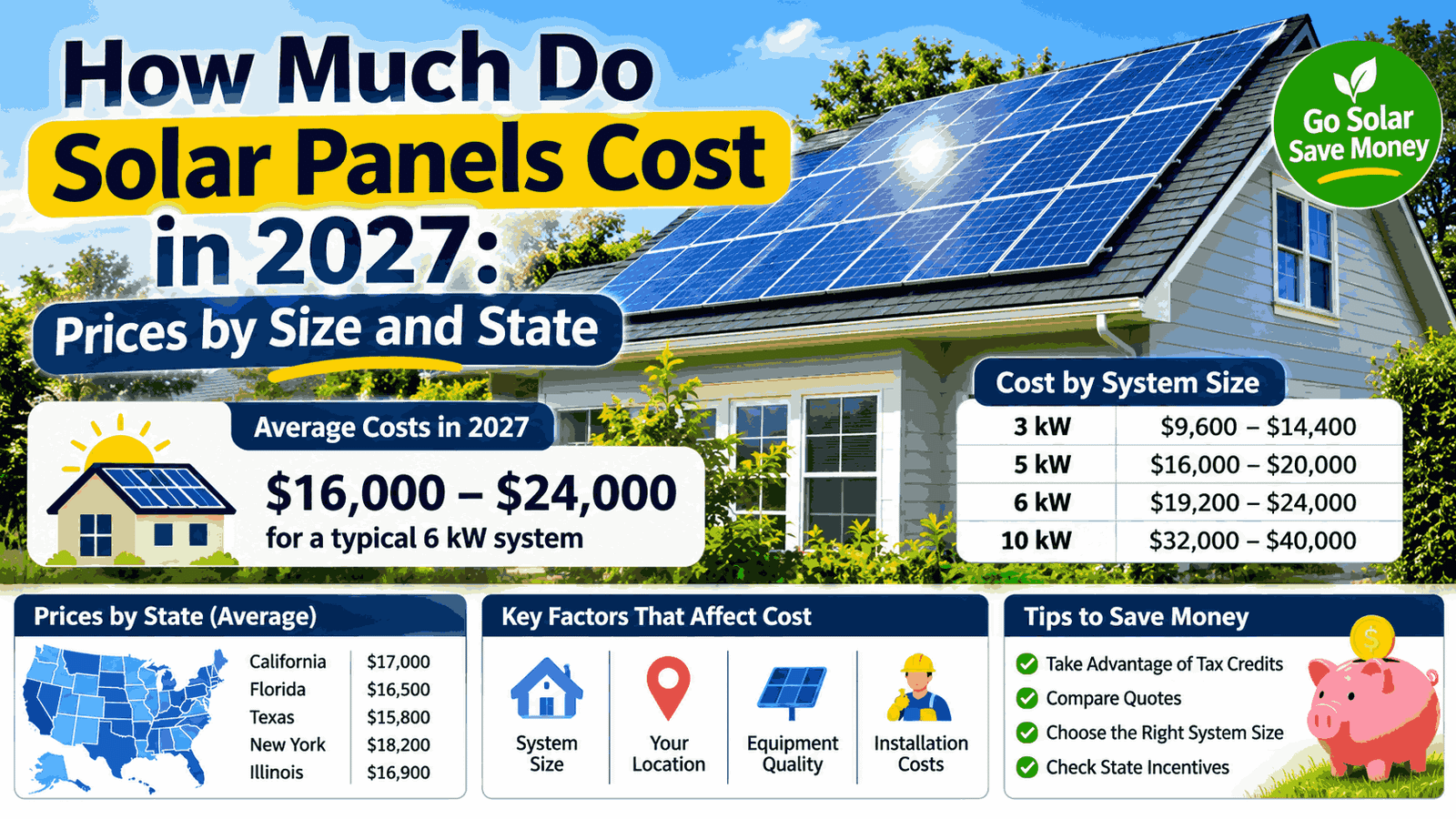
How Much Do Solar Panels Cost in 2027? Prices by Size and State
Estimated U.S. residential solar prices • Updated for 2027 planning
Introduction
Installing solar panels can help homeowners reduce their electricity bills, generate their own power, and become less dependent on traditional utility electricity. However, switching to solar energy requires an upfront investment, and the total cost can vary significantly from one home to another.
One of the most important questions homeowners ask before installing a solar system is: How much do solar panels cost in 2027?
The price depends on several factors, including system size, panel efficiency, inverter type, installation labor, roof condition, location, and available incentives. A small residential system may cost considerably less than a large installation designed to power a home with high electricity consumption.
In the United States, recent residential solar pricing data provides a useful starting point for estimating 2027 installation costs. Based on 2026 market pricing, homeowners can use approximately $2.50 to $3.50 per watt as a broad planning range for many residential installations, although actual quotes can fall outside it.
How Much Do Solar Panels Cost in 2027?
The estimated cost of installing residential solar panels in 2027 will depend primarily on the size of the system and the price per watt charged by the installer.
For planning purposes, many homeowners can use an estimated range of $2.50 to $3.50 per watt for a standard grid-connected residential solar installation. This is a planning estimate based on recent market pricing, not a guaranteed 2027 quote.

A homeowner installing a 6-kilowatt solar system could expect a total cost of approximately $15,000 to $21,000 before applicable incentives, upgrades, or additional equipment.
| System size | Estimated price in 2027 |
|---|---|
| 3 kW | $7,500–$10,500 |
| 4 kW | $10,000–$14,000 |
| 5 kW | $12,500–$17,500 |
| 6 kW | $15,000–$21,000 |
| 7 kW | $17,500–$24,500 |
| 8 kW | $20,000–$28,000 |
| 10 kW | $25,000–$35,000 |
| 12 kW | $30,000–$42,000 |
| 15 kW | $37,500–$52,500 |
These estimates generally represent a complete installed solar system, including panels, inverters, mounting hardware, electrical work, and installation. The exact inclusions depend on the installer.
Recent market data shows that installed costs can differ significantly depending on whether a homeowner purchases a system with cash, uses financing, or chooses a different installer or equipment package.
What Is the Average Cost of a Solar Panel System?
The average solar installation price depends on how much electricity your household uses throughout the year.
A small home with relatively low electricity consumption may need only a 4 kW system. A larger household using air conditioning, electric appliances, or an electric vehicle may need a 10 kW or larger solar system.
For many homeowners, a 6 kW to 10 kW system provides a useful starting point when comparing solar installation quotes.
| Solar system | Estimated installed cost | Best suited for |
|---|---|---|
| 4 kW | $10,000–$14,000 | Smaller homes or low energy use |
| 5 kW | $12,500–$17,500 | Small to average homes |
| 6 kW | $15,000–$21,000 | Moderate electricity use |
| 8 kW | $20,000–$28,000 | Average to higher electricity use |
| 10 kW | $25,000–$35,000 | Large homes or higher consumption |
| 12 kW | $30,000–$42,000 | High energy consumption |
| 15 kW | $37,500–$52,500 | Very high electricity usage |
The actual system size should be based on your electricity bills, available roof space, local solar conditions, and utility compensation rules rather than home square footage alone.
How Much Do Solar Panels Cost by System Size?
Solar installation prices usually increase with system size, but the cost per watt may decrease as the system gets larger. This happens because certain installation costs, such as design, permitting, labor setup, and equipment preparation, are spread across more panels.
3 kW Solar System Cost
A 3 kW solar system may cost approximately $7,500 to $10,500 in 2027.
This size may work for smaller homes, cabins, or households with modest electricity consumption. It can also be an option for homeowners who want to offset part of their electricity usage instead of covering most of it.
4 kW Solar System Cost
A 4 kW system may cost around $10,000 to $14,000.
This system can be suitable for smaller households with efficient appliances and moderate energy consumption. It may generate enough electricity to offset a meaningful portion of household energy use, depending on local sunlight and electricity consumption.
5 kW Solar System Cost
A 5 kW solar installation may cost approximately $12,500 to $17,500.
It is a popular size for homeowners looking to balance installation costs and electricity savings. The amount of energy it produces will vary depending on the climate, roof orientation, panel efficiency, and shading.
6 kW Solar System Cost
A 6 kW solar system may cost approximately $15,000 to $21,000.
This size is often considered a practical option for households with moderate energy needs. It can provide substantial electricity during sunny hours and reduce the amount of energy purchased from the utility.
8 kW Solar System Cost
An 8 kW solar system may cost around $20,000 to $28,000.
Larger households, homes with heavy air-conditioning use, or homeowners who expect to increase their electricity consumption may consider this system size.
10 kW Solar System Cost
A 10 kW system may cost approximately $25,000 to $35,000.
This system may be suitable for homes with high electricity consumption, larger roofs, electric vehicles, or multiple high-energy appliances.
12 kW and 15 kW Solar System Cost
A 12 kW system may cost between $30,000 and $42,000, while a 15 kW installation may cost approximately $37,500 to $52,500.
These systems are generally designed for larger homes, high electricity usage, or households with substantial energy requirements. A professional installer should determine whether the roof, electrical equipment, and utility connection can support the proposed system.
Solar Panel Cost by State in 2027
Solar panel installation costs can vary significantly from state to state. Homeowners in some states may benefit from lower installation prices, stronger competition among installers, or lower permitting costs. In other states, labor, equipment, permitting, and local market conditions can increase the final price.
Recent pricing data shows differences between states such as Arizona, Florida, Texas, California, Massachusetts, and North Carolina. However, the lowest price per watt does not always mean the lowest overall cost, because system size and electricity consumption also matter.

Estimated Solar Cost per Watt by State
The following table provides broad 2027 planning ranges for installed residential solar. These are estimates rather than verified 2027 state averages. State pricing is influenced by installer competition, labor, equipment, permits, roof conditions, and system size.
| State | Estimated cost per watt |
|---|---|
| Alabama | $2.70–$3.80 |
| Alaska | $3.00–$4.10 |
| Arizona | $2.40–$3.20 |
| Arkansas | $2.50–$3.40 |
| California | $2.50–$3.50 |
| Colorado | $2.60–$3.50 |
| Connecticut | $2.70–$3.70 |
| Delaware | $2.60–$3.60 |
| Florida | $2.40–$3.30 |
| Georgia | $2.50–$3.40 |
| Hawaii | $3.00–$4.10 |
| Idaho | $2.60–$3.50 |
| Illinois | $2.70–$3.70 |
| Indiana | $2.60–$3.50 |
| Iowa | $2.70–$3.70 |
| Kansas | $2.60–$3.50 |
| Kentucky | $2.60–$3.50 |
| Louisiana | $2.50–$3.40 |
| Maine | $2.80–$3.80 |
| Maryland | $2.70–$3.80 |
| Massachusetts | $2.80–$3.90 |
| Michigan | $2.70–$3.70 |
| Minnesota | $2.80–$3.80 |
| Mississippi | $2.50–$3.40 |
| Missouri | $2.60–$3.50 |
| Montana | $2.70–$3.70 |
| Nebraska | $2.80–$3.80 |
| Nevada | $2.40–$3.30 |
| New Hampshire | $2.80–$3.80 |
| New Jersey | $2.70–$3.80 |
| New Mexico | $2.50–$3.40 |
| New York | $2.80–$3.90 |
| North Carolina | $2.70–$3.90 |
| North Dakota | $2.80–$3.90 |
| Ohio | $2.60–$3.60 |
| Oklahoma | $2.60–$3.50 |
| Oregon | $2.70–$3.70 |
| Pennsylvania | $2.70–$3.70 |
| Rhode Island | $2.80–$3.80 |
| South Carolina | $2.60–$3.50 |
| South Dakota | $2.80–$3.90 |
| Tennessee | $2.60–$3.60 |
| Texas | $2.40–$3.40 |
| Utah | $2.50–$3.50 |
| Vermont | $2.80–$3.90 |
| Virginia | $2.60–$3.60 |
| Washington | $2.40–$3.50 |
| West Virginia | $2.70–$3.70 |
| Wisconsin | $2.70–$3.80 |
| Wyoming | $2.80–$3.90 |
These ranges are editorial estimates for 2027 planning, not official state pricing forecasts or installer quotes. Actual prices may be outside these ranges.
Which States Have Cheaper Solar Installation Costs?
States with competitive solar markets, relatively straightforward installation conditions, and strong installer availability may offer lower installation prices.
Recent market data has shown comparatively low pricing in states such as Arizona and Florida, while prices in some other markets may be higher because of labor, permitting, equipment, or financing differences.
EnergySage+1
Homeowners should compare the complete installation price rather than focusing only on the cost per watt.
For example:
-
A lower-cost solar system may have less expensive equipment or a smaller system.
-
A higher-priced installation may include premium panels, stronger warranties, upgraded inverters, or additional electrical work.
-
Two homes in the same state may receive very different solar quotes because of their roof conditions and electricity usage.
How Much Does Solar Installation Cost?
The price of solar panels is only one part of a complete solar installation. Homeowners also pay for equipment, mounting hardware, electrical components, labor, permits, and other services required to connect the system safely.
In many residential installations, these additional expenses represent a substantial share of the total project cost.
Solar Installation Cost Breakdown
| Installation component | What it includes |
|---|---|
| Solar panels | Photovoltaic modules that generate electricity |
| Inverter | Converts solar electricity into usable household power |
| Mounting system | Rails, brackets, roof attachments, and hardware |
| Electrical wiring | Cabling, disconnects, and electrical connections |
| Labor | Installation, testing, and commissioning |
| Permits | Local permits and inspection fees |
| Interconnection | Utility approval and grid connection |
| Installer overhead | Design, administration, business expenses, and profit |
Recent cost breakdowns suggest that panels themselves may account for only a relatively small portion of the full installation price. Labor, electrical equipment, permitting, overhead, and other costs contribute significantly to the final amount.

The cost of individual solar panels is much lower than the price of an entire installed system.
For example, a modern residential solar panel rated at 400 watts might cost around $150 to $300 as an individual module, depending on the brand, efficiency, technology, supplier, and purchasing quantity.
However, homeowners usually cannot simply purchase panels and expect the total project to cost the same as the sum of the panel prices. The system also requires inverters, mounting equipment, wiring, installation labor, and other electrical components.
| Solar panel wattage | Estimated panel-only price |
|---|---|
| 350 W | $130–$260 |
| 400 W | $150–$300 |
| 450 W | $170–$340 |
| 500 W | $190–$400 |
Illustrative panel-only estimates. These are not installed system prices or confirmed 2027 retail quotes.
How Much Does a Solar Battery Add to the Cost?
Solar panels generate the most electricity during daylight hours, but many households use more electricity in the evening when solar production is lower.
A solar battery allows homeowners to store some of the electricity generated during the day and use it later.
Adding battery storage can increase the overall installation price substantially. Battery costs depend on capacity, brand, installation complexity, backup equipment, and whether the home needs partial or whole-house backup.

Estimated Solar Battery Costs
| Battery capacity | Estimated installed cost |
|---|---|
| 5 kWh | $4,000–$7,000 |
| 10 kWh | $7,000–$12,000 |
| 13.5 kWh | $9,000–$15,000 |
| 20 kWh | $13,000–$22,000 |
These prices are broad planning estimates and may vary depending on the installation and battery equipment.
Solar Panels vs. Solar Panels With Battery Storage
| Feature | Solar panels only | Solar panels + battery |
|---|---|---|
| Initial cost | Lower | Higher |
| Daytime electricity savings | Yes | Yes |
| Electricity storage | No | Yes |
| Evening solar usage | Limited without storage | Improved |
| Backup during outages | Usually unavailable | Possible with suitable configuration |
| Grid dependence | Higher | Potentially lower |
A battery may be worthwhile if your utility pays very little for exported electricity, electricity rates are high at night, or backup power is important to your household.
However, if your utility provides favorable export credits, a solar-only system may offer better financial value.
What Factors Affect Solar Panel Costs in 2027?
The final cost of a residential solar installation depends on more than the number of panels on your roof. Several factors can influence how much you pay.
1. System Size
Larger systems require more panels, mounting equipment, and electrical components. Although the total price increases, the price per watt may be lower for larger installations.
2. Solar Panel Efficiency
High-efficiency panels produce more electricity from a smaller roof area. They can be useful for homes with limited roof space, although premium panels may cost more.
3. Roof Condition and Design
A simple roof with enough open space is generally easier and less expensive to install solar panels on.
Complicated roof designs, steep slopes, multiple roof sections, skylights, or roof repairs may increase installation costs.
4. Installation Labor
Labor costs differ across states and cities. Local wages, installer availability, project complexity, and demand for solar services can all affect the final quote.
5. Inverter Type
Solar systems may use string inverters, microinverters, or power optimizers. Different technologies have different equipment costs, performance characteristics, and maintenance considerations.
6. Electrical Panel Upgrades
Some homes require electrical panel upgrades or additional electrical work before solar panels can be installed. This can add hundreds or thousands of dollars to the project.
7. Permits and Utility Requirements
Building permits, inspections, utility interconnection fees, and other local requirements may add to the total cost.
8. Financing Options
Cash purchases, solar loans, leases, and power purchase agreements can have different pricing structures.
A financed solar installation may have a higher quoted project price than a cash purchase. Homeowners should compare the total repayment amount, interest, dealer fees, monthly payment, and contract terms instead of looking only at the advertised monthly cost.
Are Solar Panels Worth It in 2027?
Solar panels may be worth the investment for homeowners who pay high electricity rates, have suitable roofs, receive enough sunlight, and plan to stay in their homes long enough to benefit from the savings.
The financial value of solar depends on how much electricity the system generates and how much of that electricity offsets utility purchases.
Potential Benefits of Solar Panels
-
Reduce monthly electricity bills.
-
Lower dependence on utility electricity.
-
Protect against some future electricity price increases.
-
Generate clean energy.
-
Potentially increase the appeal of a home to energy-conscious buyers.
-
Reduce electricity expenses over the long term.
Potential Disadvantages
-
High upfront installation cost.
-
Savings depend on local electricity rates and utility policies.
-
Roof repairs may be necessary before installation.
-
Financing can increase the total cost.
-
Solar production changes with weather, seasons, and shading.
-
Inverters may need replacement before the solar panels reach the end of their useful life.
Solar panels generally make the most financial sense when a homeowner carefully compares the installation cost against expected electricity savings rather than relying on a sales estimate alone.
How Much Can You Save With Solar Panels?
Solar savings depend on your electricity bill, system size, sunlight, electricity rates, and how much of the solar energy you use directly.
Consider a hypothetical homeowner who installs a 6 kW solar system for $18,000.
If the system produces enough electricity to save $150 per month, the estimated annual savings would be:
-
Monthly savings: $150
-
Annual savings: $1,800
-
System cost: $18,000
The simple payback period would be:
$18,000%$1,800=10years
This means the homeowner could recover the initial system cost in approximately 10 years through electricity savings, assuming the savings remain constant.
| Estimated monthly savings | Annual savings | $18,000 system simple payback |
|---|---|---|
| $100 | $1,200 | 15 years |
| $150 | $1,800 | 10 years |
| $200 | $2,400 | 7.5 years |
| $250 | $3,000 | 6 years |
This is a simplified calculation. Actual payback can be longer or shorter because of electricity price changes, maintenance, inverter replacement, financing, system degradation, and utility export rates.
Solar Tax Credits and Incentives in 2027
Solar incentives can reduce the amount homeowners pay for a solar installation, but available programs depend on where you live and how your system is purchased or installed.
Federal residential solar tax incentives have changed, so homeowners should not automatically assume that a previous 30% federal tax credit is available for systems installed in 2027.
According to current information, the federal residential Clean Energy Credit under Section 25D is no longer available for qualifying residential expenditures made after December 31, 2025.
Types of Solar Incentives
| Incentive | How it may help |
|---|---|
| State tax credits | Reduce eligible state tax liability |
| Local rebates | Reduce upfront installation costs |
| Utility incentives | Provide rebates or bill-related benefits |
| Property tax exemptions | May reduce the taxable value impact of solar |
| Solar financing programs | Offer lower-cost financing or special loan terms |
| Battery incentives | May reduce the cost of qualifying storage equipment |
Not every incentive is available in every state, and program funding or eligibility requirements may change.
Homeowners can research available state and local solar incentives through the DSIRE database.
Official resource: https://www.dsireusa.org/
Before purchasing a system, check the latest rules with your state energy office, utility provider, and a qualified tax professional.
How to Lower Solar Panel Installation Costs
Solar panels can be a significant investment, but there are several ways to reduce the total cost.
1. Get Multiple Solar Quotes
Compare at least three quotes from different installers. A lower price does not necessarily mean better value, so review the equipment, warranties, installation services, and financing terms.
2. Compare Equipment
Look at panel efficiency, product warranties, inverter type, monitoring features, and manufacturer reputation.
Avoid choosing equipment based only on the advertised wattage.
3. Choose the Right System Size
Installing more solar panels than you need may increase your upfront cost without delivering proportional savings.
Review your electricity usage over the past 12 months before deciding on system size.
4. Consider Cash Purchase Versus Financing
Cash purchases can avoid interest and financing charges. Solar loans may make installation more affordable upfront, but you should compare the total amount paid over the loan term.
5. Check Local Incentives
State, local, and utility programs may provide financial assistance or rebates.
6. Avoid Unnecessary Add-Ons
Some solar proposals include optional monitoring packages, electrical upgrades, or additional services that may not be necessary for every homeowner.
Ask the installer to explain every charge in the quote.
7. Compare Warranty Coverage
A good warranty can protect you against unexpected equipment or workmanship costs.
Check panel warranties, inverter warranties, installation workmanship coverage, and service response terms.
How to Calculate Your Solar Panel Installation Cost
You can estimate the price of a solar system by multiplying its capacity by the installation cost per watt.
For example, if you want a 7 kW solar system and the installer charges $2.80 per watt:
-
System size: 7,000 watts
-
Installation cost per watt: $2.80
The estimated installation cost would be $19,600 before any applicable incentives or additional charges.
You can use the same formula to compare different installation quotes.
| System size | At $2.50/W | At $2.80/W | At $3.50/W |
|---|---|---|---|
| 4 kW | $10,000 | $11,200 | $14,000 |
| 5 kW | $12,500 | $14,000 | $17,500 |
| 6 kW | $15,000 | $16,800 | $21,000 |
| 8 kW | $20,000 | $22,400 | $28,000 |
| 10 kW | $25,000 | $28,000 | $35,000 |
| 12 kW | $30,000 | $33,600 | $42,000 |
This calculation is useful when reviewing quotes because it helps you identify whether the installer is charging a competitive price for the proposed system size.
Frequently Asked Questions About Solar Panel Costs in 2027
How much does a 6 kW solar system cost in 2027?
A 6 kW residential solar system may cost approximately $15,000 to $21,000 installed before incentives, based on an estimated price of $2.50 to $3.50 per watt.
How much does a 10 kW solar system cost?
A 10 kW solar system may cost between $25,000 and $35,000 installed. The final price depends on equipment, roof conditions, labor, and local installation rates.
What is the cheapest state to install solar panels?
Solar installation prices vary by market and installer. Recent pricing data has shown relatively competitive prices in states such as Arizona and Florida, but actual quotes vary by system size, location, and equipment.
EnergySage+1
Do solar panels cost less in 2027?
Prices may change in 2027 as equipment costs, installer competition, labor, supply chains, and financing conditions change. Homeowners should compare current quotes instead of assuming solar prices will automatically decrease.
How much does a solar system cost for a 2,000-square-foot house?
The size of a home does not determine the solar system price by itself. Electricity consumption, air conditioning, appliances, roof space, and energy efficiency are more important.
A 2,000-square-foot house might need a 6 kW, 8 kW, 10 kW, or larger system depending on its electricity usage.
Is solar cheaper than electricity from the utility?
Solar may be cheaper over the long term if the installation cost is reasonable and the system produces enough electricity to offset expensive utility purchases.
However, savings depend on your electricity rates, financing costs, solar production, and utility compensation for excess electricity.
How many solar panels do I need for my home?
A typical 400-watt panel can be used as a simple planning example.
| System size | Approximate number of 400 W panels |
|---|---|
| 3 kW | 8 panels |
| 4 kW | 10 panels |
| 5 kW | 13 panels |
| 6 kW | 15 panels |
| 8 kW | 20 panels |
| 10 kW | 25 panels |
| 12 kW | 30 panels |
| 15 kW | 38 panels |
The actual number depends on panel wattage and the final system design.
Do solar panels require maintenance?
Solar panels generally require relatively little maintenance, but homeowners should periodically check for dirt, debris, shading, damaged wiring, and changes in system production.
Professional inspections may be useful if the system stops generating expected electricity or displays an inverter warning.
Can solar panels eliminate my electricity bill?
Solar panels can significantly reduce electricity bills, but they do not necessarily eliminate every utility charge.
Fixed monthly fees, electricity imported at night, lower export compensation, and other utility charges may still result in a bill.
Is a solar battery worth the extra cost?
A solar battery may be worth it if you need backup power, want to use more solar electricity after sunset, or have unfavorable export rates.
However, batteries add substantial upfront cost. Homeowners should compare the battery’s expected savings and backup benefits against its purchase and installation price.
Final Thoughts
Solar panels in 2027 may cost approximately $2.50 to $3.50 per watt for many residential installations, giving homeowners a broad planning estimate of $15,000 to $21,000 for a 6 kW system and $25,000 to $35,000 for a 10 kW system.
However, solar installation prices vary considerably across the United States. Your location, electricity consumption, roof condition, equipment selection, installer, and financing option can all influence the final cost.
The best way to determine whether solar panels are worth it is to compare several detailed installation quotes, estimate your expected annual electricity savings, and review any state or utility incentives available in your area.
A properly sized solar system can reduce electricity expenses for many years, but choosing the right system is just as important as finding the lowest installation price.
Understanding system costs, equipment, incentives, and payback calculations can help you make a smarter solar investment in 2027.