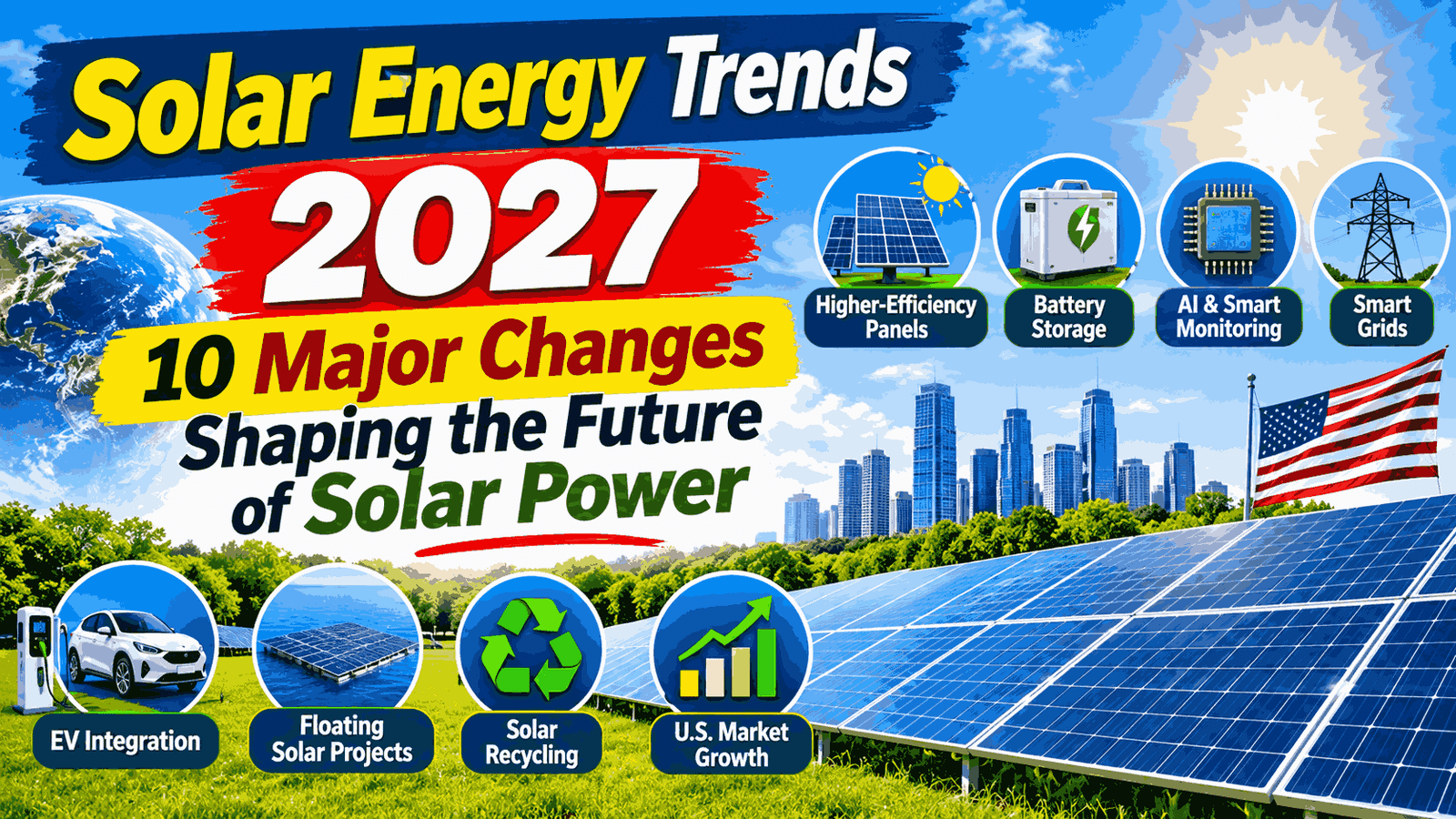
Solar Energy Trends 2027: 10 Major Changes Shaping the Future of Solar Power
Introduction
Solar energy is entering an important period of transformation. As electricity demand increases and businesses and homeowners look for alternative energy solutions, solar power is becoming an increasingly important part of the global energy market. New technologies, battery storage, changing energy policies, and improvements in solar panel manufacturing are expected to influence the industry throughout 2027.
The solar sector has moved beyond rooftop panel installations alone. It is evolving into a broader energy ecosystem encompassing smart monitoring, advanced battery storage, electric vehicle charging, and more efficient electricity management.
For homeowners, businesses, investors, and energy professionals, understanding these developments can help with long-term planning and investment decisions.
In this article, we explore 10 major solar energy trends for 2027, including technological innovations, market opportunities, battery developments, and the future of renewable electricity.
1. Higher-Efficiency Solar Panels Are Becoming More Important
One of the biggest developments in the solar industry is the continued improvement of photovoltaic (PV) technology. Manufacturers are working to produce panels that generate more electricity from the same amount of sunlight.
Modern technologies such as TOPCon and heterojunction (HJT) are helping manufacturers improve solar cell performance. These technologies are attracting attention because they can offer higher efficiency and improved performance compared with many older conventional products.
Higher-efficiency panels are especially valuable for homes and commercial buildings with limited rooftop space. They can help property owners produce more electricity without expanding the installation area.
In 2027, buyers are likely to focus more closely on panel efficiency, temperature coefficients, product warranties, and long-term degradation rates, rather than selecting equipment based solely on its advertised wattage.
2. Battery Storage Will Play a Bigger Role in Solar Energy
Solar panels generate electricity during daylight hours, but household and business electricity demand does not always follow the same schedule. Battery storage helps address this challenge.
Solar batteries allow users to store surplus electricity and use it later when solar generation decreases. This can improve energy flexibility and help reduce dependence on electricity from the grid.
Lithium-ion batteries remain widely used, while lithium iron phosphate (LFP) technology has become an important option for stationary energy storage.
In 2027, battery storage is expected to remain a major area of development. Improvements in battery management systems, energy capacity, safety features, and system integration could make solar-plus-storage solutions more attractive.
For homeowners, the value of a battery depends on electricity prices, local utility rules, backup requirements, and the cost of installation.
3. Artificial Intelligence Will Improve Solar System Management
Artificial intelligence is becoming an important tool across the renewable energy industry.
Solar installations produce large amounts of performance data. AI-powered software can help analyze this information, identify unusual production patterns, and support predictive maintenance.
For example, monitoring platforms may detect when an inverter is underperforming or when a solar installation is generating less electricity than expected under similar weather conditions.
AI can also help energy companies forecast electricity generation by analyzing weather conditions, historical production, and consumption patterns.
In 2027, smarter monitoring systems could make solar installations easier to manage and help operators identify performance problems earlier.
However, AI does not replace professional inspections or qualified electrical maintenance. It is best viewed as a tool that supports better system management.
4. The U.S. Solar Market Will Continue to Evolve
The United States remains an important market for solar energy, with residential, commercial, and utility-scale projects contributing to industry development.
Solar adoption is influenced by electricity prices, installation costs, financing options, government policy, and the availability of grid connections.
In 2027, the U.S. solar market will need to adapt to changing economic conditions and energy regulations. Federal and state incentives, permitting requirements, tariffs, and utility policies may influence the financial attractiveness of new installations.
Large-scale solar projects are also expected to remain important as electricity demand grows.
For consumers and businesses, the most useful approach is to evaluate solar investments using local electricity rates, available incentives, installation costs, and realistic energy-production estimates.
5. Solar Energy and Electric Vehicles Will Become More Connected
Electric vehicles are creating new opportunities for solar energy systems.
Homeowners with rooftop solar installations can potentially use their electricity to charge electric vehicles during periods of strong solar generation. This creates a connection between clean electricity production and transportation.
Businesses can also explore solar-powered EV charging facilities for employees, customers, and commercial vehicle fleets.
Another developing concept is bidirectional charging, which allows compatible electric vehicles to send electricity back to a building or the grid. However, this requires suitable vehicle, charger, and electrical-system compatibility.
In 2027, integration between solar panels, EV chargers, home energy management systems, and batteries could become an increasingly important part of residential and commercial energy planning.
6. Floating Solar Projects Could Expand
Traditional solar farms require suitable land, but land availability can be a challenge in some regions.
Floating solar, also known as floatovoltaics, offers another option. These systems install photovoltaic panels on floating structures placed on suitable bodies of water, such as reservoirs and industrial water facilities.
Floating solar projects can make use of existing water surfaces instead of competing directly for additional land.
In certain locations, water can help moderate panel temperatures, potentially supporting improved operating performance. Actual results depend on the project design, local conditions, and environmental factors.
However, floating solar also presents challenges, including installation costs, water-related corrosion, anchoring requirements, maintenance access, and environmental considerations.
As engineering and project experience improve, floating solar may become a useful addition to the renewable energy mix in selected markets.
7. Solar Panels Designed for Hot Climates Will Attract More Attention
Solar panels need sunlight to generate electricity, not high temperatures. In fact, excessive heat can reduce their instantaneous power output.
When solar cell temperatures increase, voltage generally decreases. This means a panel may produce less electricity during a very hot afternoon than it would under otherwise similar sunlight conditions at a lower operating temperature.
For this reason, temperature coefficients are becoming an important specification when comparing solar panels.
For example, a panel with a power temperature coefficient of -0.30% per °C generally experiences a smaller temperature-related power reduction than a comparable panel rated at -0.40% per °C.
Other factors, including mounting design, ventilation, wind, panel construction, and installation quality, also influence performance.
In 2027, consumers in hot regions may place greater importance on heat performance when selecting solar equipment.
The best buying decision should consider the complete manufacturer datasheet, warranty, installation cost, and expected electricity production in the local climate.
8. Smart Grids Will Support Greater Solar Integration
As more solar installations connect to electricity networks, managing the balance between electricity generation and consumption becomes increasingly important.
Smart grids use digital communication, monitoring equipment, and advanced control systems to improve the management of electricity networks.
These systems can help utilities monitor changing electricity demand, manage distributed energy resources, and respond to fluctuations in renewable generation.
Smart inverters are another important development. Depending on their capabilities and local grid requirements, they can provide functions that support voltage management and grid stability.
In 2027, improved grid technology will be an important part of integrating more rooftop solar, battery storage, and large-scale renewable energy projects.
The expansion of solar power will therefore depend not only on better panels but also on improvements to electricity infrastructure.
9. Solar Manufacturing and Supply Chains Will Remain Important
Solar panel prices and availability are influenced by more than technology. Manufacturing capacity, raw material costs, transportation, trade policies, and international competition all play important roles.
The solar industry has experienced major changes in global manufacturing capacity over recent years. These developments have increased competition and contributed to changes in equipment pricing.
However, supply-chain concentration and trade restrictions can create risks for manufacturers, distributors, and installation companies.
In 2027, supply-chain diversification, domestic manufacturing initiatives, and improvements in production efficiency are likely to remain important industry topics.
For buyers, it is important to consider the manufacturer’s reputation, product certification, warranty support, and the availability of replacement equipment.
The lowest-priced panel is not automatically the best long-term investment.
10. Solar Recycling and Sustainability Will Become More Important
As the number of solar installations increases, the industry must also consider what happens to panels and other equipment at the end of their useful lives.
Solar panels contain materials that may be recovered and reused through appropriate recycling processes. Recycling can help reduce waste and support more responsible resource management.
The industry is also exploring ways to improve panel durability, manufacturing efficiency, and the recovery of valuable materials.
Battery recycling is another important issue as energy storage becomes more widely adopted.
In 2027, sustainability will increasingly involve the entire life cycle of solar equipment, from raw material sourcing and manufacturing to installation, maintenance, and eventual recycling.
Companies that plan for responsible equipment management may be better prepared for future environmental requirements and customer expectations.
Is Solar Energy Still Worth Investing in 2027?
Solar energy can still be a worthwhile investment in 2027, but the financial benefits depend on individual circumstances.
For homeowners, important considerations include:
- Local electricity prices.
- Total installation costs.
- Available incentives and financing.
- Roof orientation and shading.
- Expected electricity consumption.
- Battery storage requirements.
- Equipment warranties and maintenance.
Businesses should also consider electricity demand patterns, operating hours, available roof or land space, and the financial terms of a proposed solar project.
A professional solar assessment can help estimate expected energy production and determine whether a system makes financial sense.
Rather than relying on general claims about solar savings, buyers should compare realistic installation proposals using local conditions and electricity rates.
FAQs
What are the biggest solar energy trends for 2027?
Major trends include higher-efficiency solar panels, battery storage, artificial intelligence, smart grids, electric vehicle integration, floating solar projects, and improved recycling systems.
Will solar panel prices decrease in 2027?
Solar equipment prices depend on manufacturing costs, supply and demand, transportation, trade policies, and installation expenses. Prices may vary between countries and product categories, so buyers should compare current local quotations.
Are solar batteries worth buying in 2027?
Solar batteries can be useful for storing surplus electricity and providing backup power where compatible systems are available. Their financial value depends on electricity tariffs, utility rules, battery costs, and household energy needs.
Which solar panel technology is best for 2027?
TOPCon, HJT, and other advanced photovoltaic technologies offer different advantages. The best option depends on efficiency, temperature performance, warranty, degradation, price, and installation conditions.
Will solar energy replace traditional electricity?
Solar energy is expected to play an increasingly important role in electricity generation, but it is unlikely to replace every other energy source by itself. Reliable electricity systems also require storage, grid infrastructure, and a balanced mix of energy resources.
Conclusion
Solar energy trends in 2027 point toward a more advanced and connected renewable energy industry. Improvements in photovoltaic technology, battery storage, artificial intelligence, electric vehicle integration, and smart grids are creating new opportunities for homeowners and businesses.
At the same time, challenges related to electricity infrastructure, manufacturing supply chains, environmental management, and evolving energy policies will affect the pace of the industry’s growth.
The future of solar power will not hinge on a single breakthrough. Rather, it will depend on advances in technology, affordability, energy storage, and more intelligent electricity management.
For those considering solar energy in 2027, the essential first step is to understand local energy requirements, compare equipment specifications, and assess realistic financial returns before making an investment.