What Is Net Metering for Solar Panels? How Credits and Electricity Bills Work
Introduction
Installing solar panels can help homeowners generate their own electricity and reduce the amount of power they purchase from a utility company. However, solar panels do not produce the same amount of electricity throughout the day. They generally generate more power during sunny hours and less in the evening or at night.
This creates an important question: What happens when your solar panels produce more electricity than your home needs?
In many areas of the United States, eligible homeowners can send excess electricity to the utility grid and receive credits on their electricity bills through a program called net metering. These credits may help offset electricity purchased from the grid when solar production is insufficient.
However, not every utility offers the same program, and excess electricity may be compensated differently depending on the state, utility company, and applicable rate plan.
In this guide, you will learn what solar net metering is, how it works, how utility credits are calculated, what happens to unused credits, and how to determine whether a net metering program is suitable for your home.
What Is Net Metering for Solar Panels?
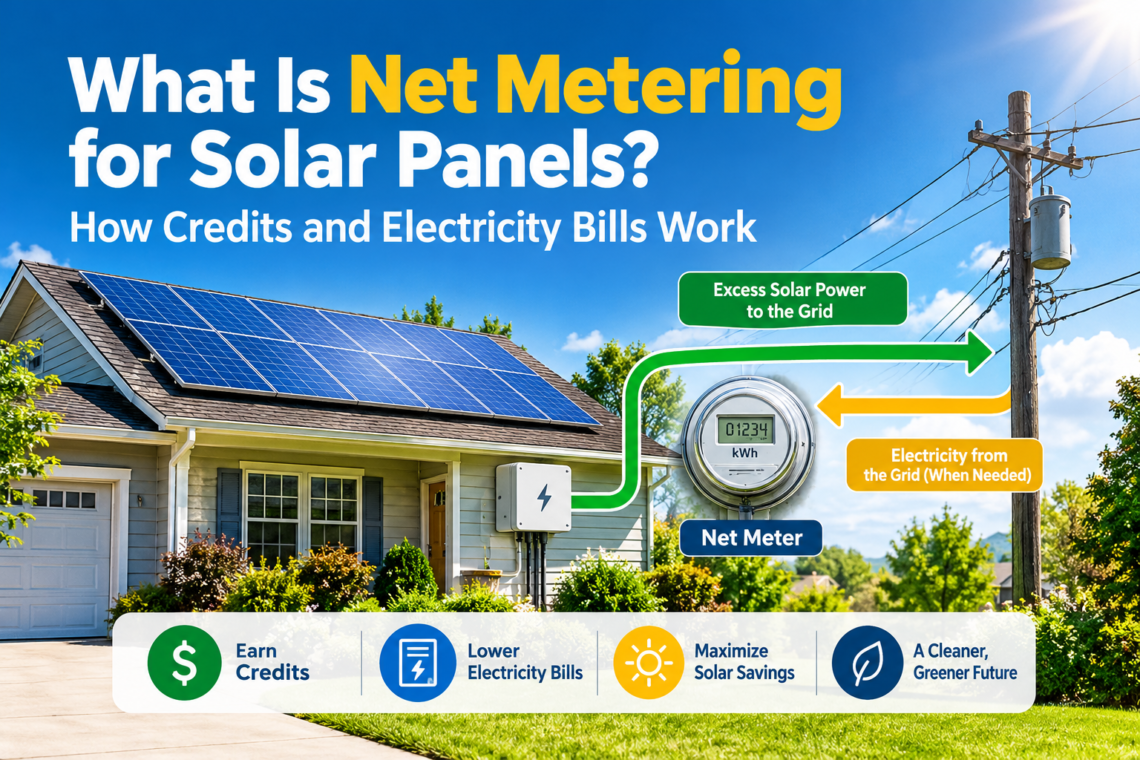
Net metering is a utility billing arrangement that allows eligible customers with solar panels or other qualifying energy systems to receive credit for electricity they send to the utility grid.
Instead of considering only the electricity your household purchases, the utility accounts for eligible electricity exported by your solar system under the applicable program rules.
For example, imagine that your solar panels generate more electricity than your home consumes during the afternoon. The excess electricity can flow into the utility grid. Later, when your solar panels produce little or no electricity, your home can draw power from the grid.
Under a traditional net metering arrangement, exported electricity can offset electricity imported from the grid over the billing period, subject to the utility’s rules.
The U.S. Department of Energy explains that net metering arrangements and the value of solar exports depend on state policies and individual utility practices.
Official resource: https://www.energy.gov/cmei/systems/homeowners-guide-solar
How Does Solar Net Metering Work?
A typical grid-connected solar system works through several steps.
Step 1: Solar Panels Generate Electricity
During daylight hours, solar panels convert sunlight into electricity. An inverter converts the electricity into a form suitable for household use and, where permitted, export to the grid.
Your home generally uses available solar electricity first, reducing the amount of power it needs to purchase from the utility.
Step 2: Your Home Uses Solar Power
Electricity generated by your solar system can operate appliances such as refrigerators, air conditioners, lighting, washing machines, and other household equipment.
If your home uses all the electricity being generated, little or no surplus may be available to export.
Step 3: Excess Electricity Goes to the Grid
When solar production exceeds household demand, the surplus can flow into the utility grid through an approved grid-connected installation.
A suitable utility meter measures electricity flowing into and out of your home, depending on the metering arrangement.
Step 4: The Utility Calculates Your Bill
Your utility applies its billing rules to determine the amount you owe and any credits you receive.
Depending on your program, the calculation may involve net electricity consumption, credits for exported electricity, fixed monthly charges, delivery charges, or other applicable fees.
Step 5: You Use Electricity When Solar Production Is Low
At night, during cloudy weather, or whenever your home needs more electricity than your solar panels produce, the utility grid can supply the difference.
Your bill reflects the electricity purchased and the credits available under your specific agreement.
Example: How Net Metering Credits Work
Consider a homeowner whose solar panels generate more electricity than the household uses during a sunny month.
The following example uses hypothetical figures to demonstrate a traditional one-for-one net metering arrangement. It is not a quotation from any particular utility.
| Monthly electricity details | Amount |
|---|---|
| Total household electricity consumption | 900 kWh |
| Solar electricity generated | 1,100 kWh |
| Solar electricity used directly at home | 400 kWh |
| Electricity exported to the grid | 700 kWh |
| Electricity imported from the grid | 500 kWh |
| Net electricity balance | 200 kWh surplus |
In this example, the home exports 700 kWh and imports 500 kWh during the billing period.
Under a qualifying one-for-one net metering arrangement, the 500 kWh of imported electricity could be offset by 500 kWh of export credits, leaving 200 kWh of net surplus.
The utility’s rules determine whether that surplus carries forward, receives a payment, expires, or is handled another way.
Even when a home exports more electricity than it imports, the homeowner may still owe fixed service fees or other charges that are not offset by energy credits.
What Are Net Metering Credits?
Net metering credits are credits a utility assigns to eligible electricity supplied by a customer’s solar system.
These credits may reduce the amount charged for electricity purchased from the grid. However, their value depends on the applicable tariff or utility program.
There are several important differences between credit systems.
1. One-for-One Electricity Credits
In a traditional one-for-one net metering arrangement, each eligible kilowatt-hour exported to the grid can offset one kilowatt-hour imported from the grid within the applicable billing rules.
For example, exporting 100 kWh may allow a customer to offset 100 kWh of electricity purchases.
This does not necessarily mean the homeowner receives a cash payment for those 100 kWh. It is an electricity billing arrangement, and other fees may remain payable.
2. Dollar-Based Bill Credits
Some programs calculate credits in dollars rather than treating exported and imported electricity as equal quantities.
For example, a utility might credit exported electricity at a specified rate per kWh.
If a customer exports 100 kWh at an illustrative rate of $0.06 per kWh, the resulting credit would be $6.
The customer may pay a different rate when purchasing electricity from the utility. In that situation, the exported electricity may be worth less than the electricity the homeowner later imports.
3. Time-Based or Time-of-Use Rates
Some utilities charge different electricity rates depending on the time of day.
If your utility uses time-of-use pricing, the value of exported electricity and the cost of imported electricity may depend on the applicable rate schedule.
This can influence whether it is more beneficial to use solar electricity immediately, export it to the grid, or store some of it in a home battery.
Always review your utility’s current tariff to understand the actual value of your solar exports.
What Is the Difference Between Net Metering and Net Billing?
Although the terms are sometimes used interchangeably in casual discussions, net metering and net billing can operate differently.
| Feature | Net metering | Net billing |
|---|---|---|
| Main purpose | Offsets eligible grid electricity use | Credits exported electricity separately |
| Export credit | May offset imported kWh at an equivalent rate | Often based on a separate export rate |
| Imported electricity | Billed according to the applicable tariff | Billed according to the applicable tariff |
| Financial outcome | Depends on credit rules and charges | Depends on export compensation and import prices |
| Availability | Varies by state and utility | Varies by state and utility |
Under net metering, the utility may calculate a net electricity balance over a billing period.
Under net billing, electricity purchased from the grid and electricity exported to the grid are generally valued separately. Export credits may be lower than the retail price paid for imported electricity, although the exact arrangement varies.
For instance, if you purchase electricity at $0.20 per kWh but receive $0.07 per kWh for exported electricity, those exports will not offset your bill dollar for dollar.
The figures above are illustrative only.
Before installing solar panels, ask your utility whether your proposed system qualifies for traditional net metering, net billing, a buyback program, or another compensation arrangement.
Do All States in the USA Offer Net Metering?
No. Solar compensation rules are not identical across the United States.
State legislation, public utility commission decisions, utility tariffs, and local electricity providers can all influence whether net metering is available and how it works.
Some important differences include:
- Whether residential customers qualify for the program.
- The maximum eligible solar system size.
- Whether investor-owned utilities, municipal utilities, and electric cooperatives follow the same rules.
- Whether exports receive retail-rate credits or a different compensation rate.
- How long unused credits remain available.
- Whether the program has special requirements for new solar installations.
- Whether additional monthly charges apply to solar customers.
A program available to an existing solar customer may also differ from the program offered to someone installing a new system.
For this reason, homeowners should not assume that a net metering policy described online applies to every utility in their state.
To research current programs, visit the Database of State Incentives for Renewables and Efficiency (DSIRE):
You should also contact your local utility and request its current residential solar tariff and interconnection requirements.
What Happens to Unused Net Metering Credits?
The treatment of unused credits depends on the program.
If your solar panels generate more electricity than you consume, you may accumulate surplus credits. Those credits may be handled in one of several ways.
Credits May Carry Forward
Some programs allow unused credits to roll over into future billing periods.
This can be useful when solar production is high during sunny months and household electricity consumption rises during other seasons.
However, rollover limits and expiration dates may apply.
Credits May Be Settled Annually
Some utility arrangements include an annual settlement or true-up process. At the end of the settlement period, the utility calculates the remaining credit balance and applies the program’s rules.
Surplus credits may receive compensation, be carried forward under specific conditions, or be treated differently according to the tariff.
Credits May Expire
Some programs limit how long credits remain available. If a credit expires, the customer may lose its remaining value.
Credits May Receive a Different Compensation Rate
A utility may compensate surplus electricity at a separate rate instead of allowing it to offset future electricity purchases at the retail rate.
Important: Do not assume that excess solar electricity will always be purchased by the utility or that credits will remain available indefinitely. Confirm the settlement, rollover, and expiration rules before investing in a solar system.
Why Is My Electricity Bill Not Zero With Solar Panels?
Installing solar panels and participating in a net metering program does not automatically eliminate every charge on your utility bill.
Even when your system generates enough electricity over a month to cover your consumption, you may still have charges that cannot be offset by solar export credits.
Common reasons include the following.
Fixed Monthly Service Fees
Utilities may charge a basic service fee for maintaining the connection to the grid. Such charges may apply regardless of how much electricity you purchase.
Electricity Delivery Charges
Depending on the tariff, some delivery-related charges may remain payable even when solar production offsets some energy consumption.
Different Import and Export Rates
If your utility pays less for exported electricity than it charges for imported electricity, your credits may not fully offset your purchases.
Solar Production Is Lower Than Expected
Cloudy weather, seasonal changes, shading, equipment problems, or inaccurate production estimates can reduce solar generation.
Higher Household Electricity Consumption
Air conditioning, electric heating, electric vehicle charging, and additional appliances may increase household demand beyond the solar system’s output.
Credit Expiration or Settlement Rules
Credits that expire or are settled under different terms may not be available when you need them.
To understand your bill, review the electricity imported, electricity exported, credit balance, applicable rates, and fixed charges separately.

Is Net Metering Better Than Installing a Solar Battery?
Net metering and home battery storage serve different purposes. The better option depends on your utility rates, energy usage, budget, and need for backup power.
Benefits of Net Metering
Net metering may allow homeowners to use the utility grid as part of their solar energy arrangement.
Potential advantages include:
- Reducing electricity purchases through eligible export credits.
- Avoiding the upfront cost of a home battery.
- Using the grid when solar production is insufficient.
- Simplifying energy management for some households.
The financial benefit depends on the compensation rate and the terms of the utility program.
Benefits of a Solar Battery
A battery stores electricity for later use rather than sending all available surplus to the grid.
Potential benefits include:
- Using stored solar electricity after sunset.
- Reducing grid purchases during selected high-rate periods.
- Providing backup electricity when the system is designed for outage operation.
- Increasing the share of solar electricity consumed at home.
However, batteries add equipment and installation costs. They also have power limits, storage losses, and finite service lives.
Which Option Should You Choose?
If your utility offers favorable net metering credits, a grid-connected solar system without a battery may be financially attractive.
If exported electricity receives a low credit rate, storing some surplus electricity may be worth evaluating.
The best comparison considers the battery’s installed cost, expected savings, backup requirements, utility tariffs, and the amount of electricity you can use directly from your solar panels.
How to Apply for Net Metering in the USA
The process varies by state and utility, but residential solar customers generally need to complete several steps before exporting electricity to the grid.
Step 1: Contact Your Utility
Ask whether residential solar net metering or another export compensation program is available at your address.
Request the current tariff, eligibility requirements, and any application deadlines.
Step 2: Choose a Qualified Solar Installer
Select an installer familiar with your local utility’s interconnection requirements.
Ask for a system design that considers your household consumption, roof conditions, expected production, and proposed export capacity.
Step 3: Submit the Required Application
Your installer or you may need to submit an interconnection application and technical documentation to the utility.
Requirements can include system specifications, inverter details, electrical diagrams, permits, and other information.
Step 4: Complete Permits and Inspections
Obtain the required local permits and arrange the necessary inspections.
The specific requirements depend on the location and installation.
Step 5: Receive Utility Approval
The utility may need to review the installation, approve the interconnection, or install or configure suitable metering equipment.
Do not assume that your solar system is authorized to export electricity simply because the panels have been installed.
Step 6: Review Your First Bill
Once the system is approved and operating, review your utility bill to confirm how electricity imports, exports, and credits are recorded.
Contact the utility if the bill does not match the agreed tariff or if the credit calculations are unclear.
How to Calculate Potential Net Metering Savings
You can estimate the potential value of net metering by comparing the electricity you purchase from the utility with the credits you receive for exported electricity.
Consider this simplified example:
- Electricity purchased from the grid: 400 kWh.
- Electricity imported rate: $0.18 per kWh.
- Electricity exported to the grid: 300 kWh.
- Export credit rate: $0.08 per kWh.
The cost of imported electricity would be:
400 kWh × $0.18 = $72.
The credit for exported electricity would be:
300 kWh × $0.08 = $24.
The energy-related amount after applying the credit would be $48, before fixed charges, taxes, and any other applicable fees.
This example demonstrates a net billing arrangement where imports and exports are valued separately. It does not represent a universal net metering formula.
Your actual bill may use a different calculation, especially if your utility provides one-for-one kWh credits or applies time-of-use rates.
Frequently Asked Questions About Solar Net Metering
Does net metering mean the electric meter runs backward?
Historically, some net metering arrangements used meters that effectively ran backward when electricity was exported. Modern systems commonly use meters capable of measuring electricity flows in both directions or separate measurements for imports and exports. The exact equipment depends on the utility.
Do utility companies pay cash for excess solar electricity?
Not necessarily. Some programs provide bill credits rather than direct cash payments. Others may compensate surplus generation under specific settlement rules. Check the applicable tariff to determine whether cash payments are available.
Can I receive net metering credits without a battery?
Yes. A battery is generally not required for a grid-connected solar system to export eligible excess electricity. Your inverter, meter, and installation must meet the utility’s interconnection requirements.
Do net metering credits expire?
They can. Some programs allow credits to roll over, while others impose expiration dates or annual settlement rules. The applicable tariff determines what happens to unused credits.
Is net metering available for every solar system?
No. Eligibility may depend on your location, utility, system size, customer type, equipment, and interconnection approval.
Can net metering eliminate my entire electricity bill?
It may significantly reduce the energy portion of your bill, but fixed fees, non-offsettable charges, and differences between import and export rates can leave a remaining balance.
Is net metering the same as selling electricity to the utility?
Not exactly. Net metering generally uses exported electricity to offset electricity supplied by the utility under a billing arrangement. Other programs may compensate exported electricity separately at a specified rate.
Final Thoughts
Net metering can make residential solar more valuable by allowing eligible homeowners to receive credits for surplus electricity supplied to the utility grid.
However, the financial benefits depend on more than the amount of electricity your panels generate. Your utility’s export rate, credit rollover rules, fixed charges, system size, and household consumption all influence the final result.
Before installing solar panels, confirm which compensation program applies to your address, ask how excess credits are calculated, and compare the expected savings with the full cost of your solar system.
Understanding these details can help you make a more informed decision and avoid unexpected electricity bills after your solar installation.
Official Resources
- U.S. Department of Energy: Homeowner’s Guide to Solar
https://www.energy.gov/cmei/systems/homeowners-guide-solar - U.S. Energy Information Administration: Net Metering Definition
https://www.eia.gov/tools/glossary/index.php?id=Net+metering - Database of State Incentives for Renewables and Efficiency (DSIRE): State and Utility Incentives
https://www.dsireusa.org/
Disclaimer: This article provides general educational information, not legal, financial, or utility-specific advice. Net metering rules, electricity rates, credit values, and eligibility requirements can change. Always verify current terms with your utility and state regulators.