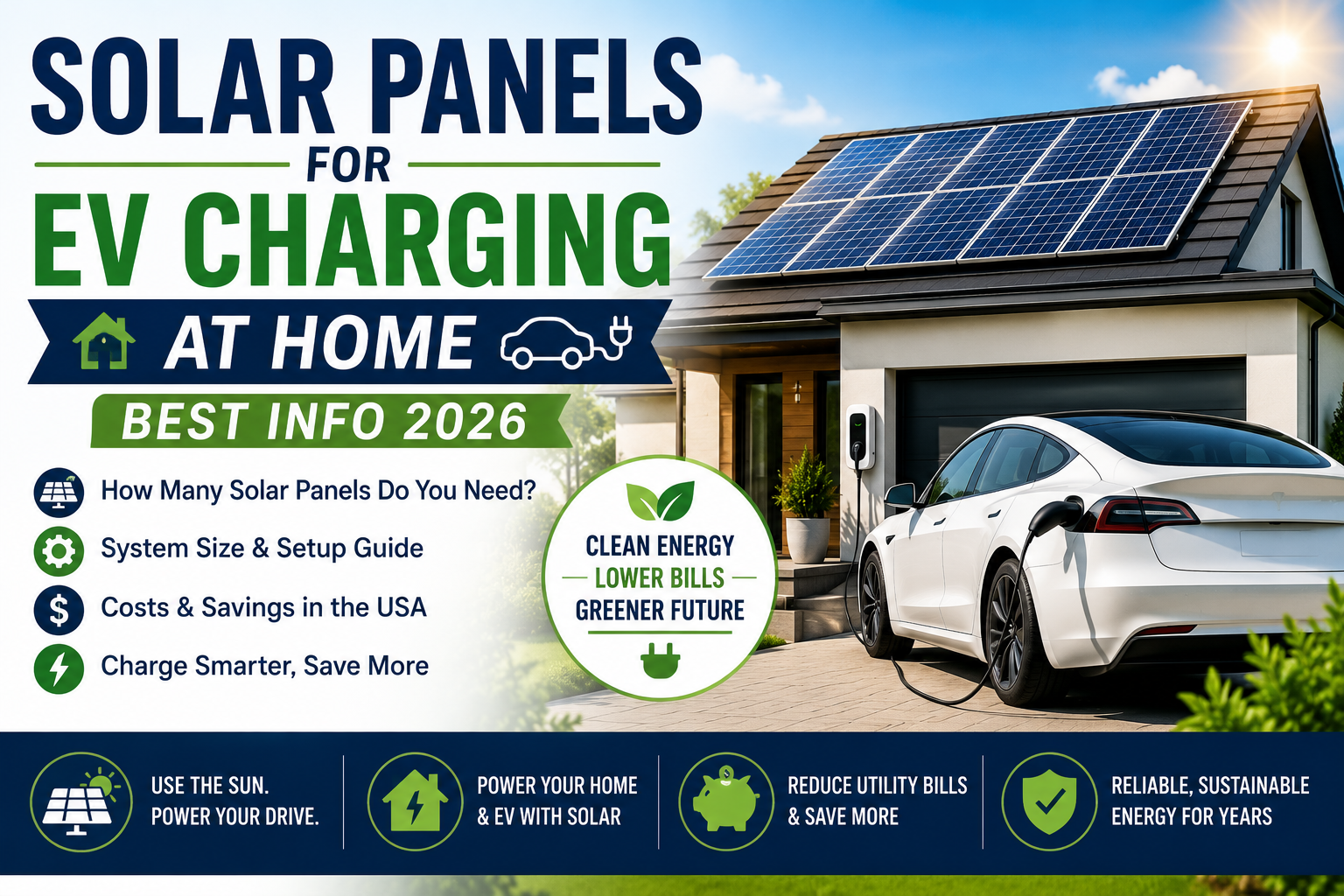
Solar Panels for EV Charging at Home Best Info 2026
Solar Panels for EV Charging at Home: System Size, Costs and Setup
Introduction
Electric vehicles (EVs) are becoming an increasingly popular option for American homeowners who want to reduce gasoline expenses and use cleaner energy. However, charging an electric car at home still requires electricity, and the cost can add up depending on how far you drive and your local utility rates.
Installing solar panels for EV charging at home can help you produce some or all of the electricity needed to charge your vehicle. By combining a residential solar system with a compatible home EV charger, you can use energy generated from sunlight to power your daily commute.
But how many solar panels do you need? Is a home battery necessary? How much does installation cost in the United States?
This guide explains solar EV charging, system sizing, equipment choices, estimated costs, potential savings, and the steps involved in setting up a home charging system.
What Is Solar EV Charging?
Solar EV charging means using electricity generated by solar panels to charge an electric vehicle. A rooftop solar system converts sunlight into electricity, which can supply household appliances and an EV charger.
There are three common ways to charge an electric vehicle using solar energy:
- Direct solar charging: Charge your EV during sunny hours when your solar panels are generating electricity.
- Grid-connected solar charging: Use solar power when available and draw electricity from the utility grid when your home needs more energy.
- Solar charging with battery storage: Store excess solar electricity in a home battery and use that stored energy later, depending on the system’s configuration.
For many homeowners, a grid-connected solar system is a practical starting point because it can support household electricity needs and vehicle charging without requiring a separate battery.
However, solar panels do not automatically provide backup power during a grid outage. Backup operation requires compatible equipment and a system specifically configured to operate safely when the grid is unavailable.
How Many Solar Panels Do You Need to Charge an Electric Car?
The number of solar panels required depends on your vehicle’s electricity consumption, daily driving distance, panel wattage, local sunlight conditions, and charging losses.
The following example illustrates how to estimate your requirements.
Suppose you drive 30 miles per day and your electric vehicle uses approximately 3 miles per kilowatt-hour (kWh).
Your estimated daily charging energy would be:
30 miles ÷ 3 miles per kWh = 10 kWh per day.
That means you need approximately 10 kWh of usable electricity daily for driving, before accounting for charging losses.
If your vehicle consumes more electricity or you drive longer distances, your solar requirements will increase.
Example Solar Panel Requirements
| Solar panel rating | Number of panels | Total system capacity |
|---|---|---|
| 350 watts | 9 panels | 3.15 kW |
| 400 watts | 8 panels | 3.20 kW |
| 450 watts | 7 panels | 3.15 kW |
These examples show how panel count translates into system capacity. They do not guarantee enough daily electricity for EV charging. Actual production depends on location, weather, roof direction, shading, season, and system losses.
For a preliminary estimate of production at your address, use the National Renewable Energy Laboratory’s PVWatts Calculator:
https://pvwatts.nrel.gov/pvwatts.php
A solar installer can use local production estimates and your actual driving habits to recommend an appropriate system size.
How Much Does It Cost to Install Solar Panels for EV Charging?
The total cost depends on whether you already have solar panels, how much additional solar capacity you need, which EV charger you choose, and whether your home’s electrical system requires upgrades.
A complete project may include solar panels, an inverter, mounting equipment, electrical wiring, permits, and an EV charging station.
Estimated Home EV Charger Costs in the USA
According to the U.S. Environmental Protection Agency’s home charging guidance, EV charging equipment can cost approximately $400–$1,000, while installation can range from $300–$2,000 depending on the home and electrical setup.
EnergySage’s June 2026 guide reports installation costs of approximately $800–$3,000 before charger equipment, reflecting different project assumptions and installation conditions.
These figures are estimates, not guaranteed prices for an individual home.
| Expense | Estimated cost |
|---|---|
| Home EV charging equipment | $400–$1,000 |
| Basic installation | $300–$2,000 |
| More complex installation | $800–$3,000 or more |
| Solar panel system | Depends on capacity, equipment and location |
| Electrical panel upgrade | Additional cost if required |
| Home battery | Additional cost if selected |
Do not simply add every range together to calculate a final project price. The installation figures come from different sources and may overlap.
For a solar-powered EV charging project, request separate quotes for the solar installation, charging equipment, electrical work, and any battery storage. Ask whether permits and inspections are included.
Level 1 vs. Level 2 EV Charging With Solar Panels
Choosing the right charger is an important part of designing your solar EV charging system.
Level 1 Charging
Level 1 charging typically uses a standard 120-volt household outlet in the United States, where the outlet and circuit are suitable for the vehicle’s charging equipment.
Advantages include:
- Often requires no additional charger installation if a suitable outlet is available.
- Can be convenient for drivers with short daily commutes.
- May work well when the vehicle can remain parked for many hours.
The main disadvantage is its slower charging speed. Drivers who travel long distances every day may find Level 1 charging insufficient for their needs.
Level 2 Charging
Level 2 charging generally uses a 240-volt supply and can deliver substantially more power than Level 1 charging.
Benefits include:
- Faster home charging.
- Greater flexibility for daily commuters.
- Convenient overnight charging.
- Better suitability for many households with higher driving requirements.
Installation may require a dedicated circuit, appropriate wiring, permits, and an electrical load assessment.
According to the U.S. EPA, charger selection and installation should take account of the home’s electrical capacity and the equipment manufacturer’s requirements.
Official guidance: https://www.epa.gov/greenvehicles/getting-started-home-ev-charging
Can Solar Panels Charge an EV at Night?
Solar panels generate electricity during daylight, so they cannot directly produce solar energy at night.
Nevertheless, you can charge an electric vehicle after sunset using several approaches.
Option 1: Use the utility grid. A grid-connected solar system may export surplus electricity during the day and draw electricity from the grid at night. Whether daytime exports offset nighttime consumption financially depends on your utility’s rates and export-credit policy.
Option 2: Install a home battery. A compatible battery can store some excess solar energy for later use. The amount available for EV charging depends on battery capacity, household demand, charging losses, and the system’s power limits.
Option 3: Schedule daytime charging. If your vehicle is parked at home during daylight hours, you may be able to schedule charging to coincide with solar production.
For homeowners who work away from home during the day, grid-connected charging or battery storage may be more practical than relying exclusively on direct daytime charging.
Do You Need a Home Battery for Solar EV Charging?
No. A home battery is not essential for every solar EV charging system.
If your home remains connected to the utility grid, the grid can provide electricity when solar production is insufficient. Your actual bill savings will depend on your electricity rate, solar export compensation, and charging schedule.
A home battery may be useful if you want to store surplus solar electricity, increase the amount of solar energy used after sunset, or provide backup power to selected household circuits during an outage.
Before purchasing a battery, compare its installed cost, usable capacity, power rating, warranty, and expected daily use.
Also confirm whether the battery and inverter can supply the EV charger’s power demand. A battery’s energy capacity, measured in kWh, is different from its power output, measured in kW.
For example, a battery with 10 kWh of usable capacity cannot necessarily supply a 10 kW load continuously. Its output rating and other system limits must also be considered.
How Much Money Can You Save by Charging an EV With Solar Power?
Potential savings depend on how much electricity your solar system produces, how much of that electricity goes into your vehicle, your utility’s rates, and the cost of installing the system.
Consider a simplified example:
- EV electricity consumption: 10 kWh per day.
- Monthly charging consumption: approximately 300 kWh.
- Illustrative electricity price: $0.15 per kWh.
At that assumed electricity rate, charging the vehicle would cost approximately $45 per month, or $540 per year, before considering charging losses or changes in electricity prices.
If solar electricity replaces some of the grid electricity you would otherwise purchase, your bill could decrease.
However, $540 is not a guaranteed annual saving. Solar equipment, installation, financing, maintenance, battery replacement, and the value of electricity exported to the grid all affect the financial outcome.
Your solar electricity also has an opportunity cost: if your utility pays you for exporting excess electricity, using that electricity to charge your car may reduce your export credits.
For a more useful comparison, ask your installer to estimate your home’s solar production, your EV’s annual charging demand, and the expected amount of grid electricity you will still purchase.
Important Factors Before Installing Solar EV Charging
Before investing in a new solar system or upgrading an existing one, consider these factors.
1. Your Daily Driving Distance
A driver who travels 15 miles daily will generally need less charging energy than someone who drives 60 miles per day.
Estimate your typical weekly mileage rather than choosing a system based only on your vehicle’s maximum battery capacity.
2. Your Solar Panel Production
Solar production varies by location and season. Roof orientation, shading, panel tilt, temperature, and equipment performance also influence output.
Use a location-specific estimate rather than assuming that every solar panel generates the same amount of electricity each day.
3. Your Electrical Panel
An electrician should assess your home’s electrical service, existing loads, available circuit capacity, and proposed charger requirements.
A panel upgrade is not always necessary. Depending on the situation, a lower-powered charger or an approved load-management system may be an alternative.
4. Roof Condition and Available Space
Check whether your roof has enough suitable space for the additional solar capacity and whether it is in good condition.
If your roof needs replacement soon, consider coordinating roof work and solar installation to avoid unnecessary removal and reinstallation costs.
5. Utility Rates and Export Policies
Electricity rates and solar export compensation differ by utility and location. Some utilities also offer time-of-use rates that make certain charging hours less expensive.
Review your utility’s current rate schedule before deciding whether to prioritize daytime charging, overnight charging, or battery storage.
6. Permits and Safety
Residential EV charger installations may require permits and inspections. Use qualified professionals and equipment approved for the intended installation.
Outdoor charging equipment must be rated for the environment in which it will operate. Do not use extension cords or improvised wiring as a substitute for a properly installed EV charging circuit.
Step-by-Step Guide to Setting Up Solar EV Charging at Home
Follow these steps to plan your project.
Step 1: Review your driving habits. Estimate your daily mileage and your vehicle’s typical electricity consumption.
Step 2: Review your existing solar system. If you already have solar panels, ask your installer to compare the system’s production with your household and EV electricity demand.
Step 3: Estimate solar production. Use the NREL PVWatts Calculator to obtain a preliminary estimate based on your location and proposed system.
Step 4: Choose an EV charger. Compare Level 1 and Level 2 charging according to your daily driving needs, vehicle compatibility, and available electrical capacity.
Step 5: Obtain an electrical assessment. A qualified electrician should evaluate the proposed circuit, wiring route, panel capacity, permits, and any required upgrades.
Step 6: Compare installation quotes. Obtain written quotes that clearly separate equipment, labor, solar installation, permits, and optional battery storage.
Step 7: Check local incentives. Search official state, utility, and local government resources for currently available EV charging or solar incentives. Confirm eligibility, deadlines, and funding availability before relying on any incentive in your budget.
Step 8: Monitor performance. After installation, compare your solar production, home electricity use, and EV charging consumption to understand how effectively your system is meeting your needs.
Is Solar EV Charging Worth It in the USA?
Solar EV charging can be a practical choice for homeowners who drive regularly, have a suitable roof, and want to use solar electricity for transportation as well as household needs.
It may be particularly attractive when a homeowner already has solar panels with sufficient production or can add capacity at a reasonable cost.
However, installing an entirely new solar system solely to charge a vehicle may require a more careful financial assessment. The outcome depends on installation costs, local sunlight, electricity prices, available incentives, and how long you plan to stay in the home.
The best approach is to size the system around your real driving habits and compare the total cost of ownership against charging from the grid.
Frequently Asked Questions
How many solar panels are needed to charge an electric car?
The number varies with daily driving distance, vehicle efficiency, panel wattage, and local solar production. Estimate your EV’s daily kWh requirement first, then use a location-specific solar production estimate to determine the required system capacity.
Can I charge my Tesla with solar panels at home?
Yes. A compatible home charging setup can charge a Tesla using electricity supplied by a residential solar system. The required equipment and charging options depend on the vehicle, charger, inverter, and home’s electrical installation.
Is a home battery necessary for solar EV charging?
No. A grid-connected system can supply electricity when solar production is insufficient. A battery is an optional addition for storing surplus solar electricity and using it later.
Can solar panels charge an EV during a power outage?
Not automatically. Most standard grid-connected solar systems shut down during an outage unless they have compatible backup equipment and are configured for safe islanded operation. Check the system design with a qualified installer.
Is Level 2 charging better for home use?
Level 2 charging is faster and often more convenient for daily commuters. Level 1 may be adequate for drivers with shorter commutes and enough time to charge. Your vehicle, charging requirements, and electrical setup should guide the choice.
Will solar charging eliminate my electricity bill?
Not necessarily. Your home will continue to use electricity, and solar production varies. Grid connection charges, nighttime usage, seasonal production, and utility export policies may leave you with a remaining bill.
Final Thoughts
Installing solar panels for EV charging at home can help American homeowners combine clean electricity with convenient vehicle charging. The right setup depends on daily driving distance, solar production, charger type, electrical capacity, and the cost of installation.
Start by calculating your EV’s electricity needs, checking your home’s solar potential, and obtaining quotes from qualified installers. Compare the expected reduction in grid electricity purchases with the total project cost before making a decision.
A properly designed system can support both household electricity use and electric vehicle charging while helping you make better-informed energy decisions.
Official Resources
- U.S. Environmental Protection Agency — Getting Started with Home EV Charging: https://www.epa.gov/greenvehicles/getting-started-home-ev-charging
- U.S. Department of Energy, Alternative Fuels Data Center — Charging Electric Vehicles at Home: https://afdc.energy.gov/fuels/electricity-charging-home
- National Renewable Energy Laboratory — PVWatts Calculator: https://pvwatts.nrel.gov/pvwatts.php
Disclaimer: Cost figures and energy examples in this article are estimates for educational purposes. Actual equipment prices, electricity rates, solar output, installation requirements, and incentive eligibility vary by location and project. Obtain professional advice and current local quotes before making purchasing or installation decisions.